The Gibraltar Border Has Changed. Here’s What It Means for Sotogrande’s Property Market.

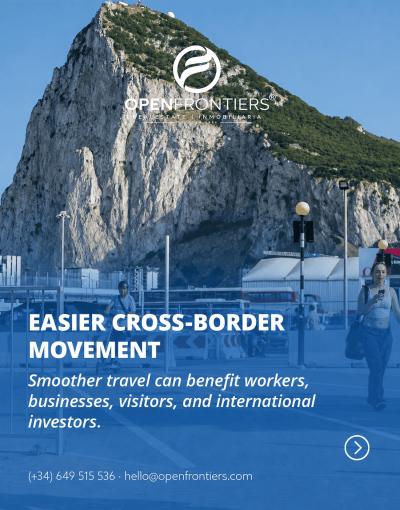



The Gibraltar border Sotogrande property market has entered a new phase: for the first time in over 300 years, people can cross between Spain and Gibraltar without routine passport checks at the land border. Since midnight on July 15, 2026, the physical barrier at La Línea de la Concepción has, in practical terms, stopped functioning as a border checkpoint — a change with real consequences for anyone living, working, or investing across the frontier.
What Actually Happened
The change follows the EU-UK Treaty on Gibraltar, formally signed in Brussels on July 14, 2026, and provisionally applied from July 15. The treaty itself is the product of a political agreement reached in June 2025 between Spain’s Foreign Minister José Manuel Albares, European Commissioner Maroš Šefčovič, and the UK’s then-Foreign Secretary David Lammy, with the full legal text published by the Spanish government in February 2026.
The key mechanics, according to the Spanish Ministry of Foreign Affairs and the Council of the European Union:
- Land border: Routine immigration checks and physical barriers at the Spain-Gibraltar land crossing are removed.
- Where checks happen instead: Immigration and Schengen border controls move to Gibraltar’s airport and, if needed, its port, carried out by Spanish authorities.
- Goods: A customs union removes tariffs, duties, and quotas between the EU and Gibraltar, with most goods bound for Gibraltar cleared through Spanish customs offices.
- Status: Gibraltar remains outside both the EU and Schengen, but Schengen rules apply at its external border under this tailored arrangement.
- Who benefits most directly: An estimated 15,000 people who cross the border daily for work, plus — according to the Spanish government — the roughly 300,000 residents of the wider Campo de Gibraltar area, through improved connectivity and investment prospects.
It’s worth being precise about the legal status: the agreement is in provisional application, not full ratification. It still requires consent from the European Parliament and formal ratification procedures in the UK. In practice, this means the border changes are operating now, but the underlying legal architecture is not yet finalized — a distinction that matters for anyone making long-term plans around it.
Before and After: What Changed at the Gibraltar Border?
The new Gibraltar border arrangements change how people and goods move between Gibraltar and Spain.
The table below summarises the main differences between the previous system and the arrangements applying from 15 July 2026.
| Topic | Before – until 14 July 2026 | After – from 15 July 2026 |
|---|---|---|
| Land border checks | Routine passport and ID checks at La Línea. | Removed – no routine checks. |
| Where immigration is checked | At the land border itself. | Gibraltar’s airport and, where necessary, the port. |
| Who carries out checks | Spanish and Gibraltar authorities at the border. | Spanish authorities under Schengen rules. |
| Goods crossing the border | Subject to tariffs, duties and quotas. | Customs union – tariffs and quotas removed. |
| Gibraltar’s EU and Schengen status | Outside both, with a hard border in effect. | Outside both, but Schengen rules apply at Gibraltar’s external border. |
| Daily commuters affected | Approximately 15,000 commuters, subject to routine checks. | Approximately 15,000 commuters crossing without routine checks. |
| Legal status of the arrangement | Not applicable. | Provisional application, with full ratification still pending. |
Why This Matters Beyond the Border Itself
The most immediate and concrete effect is on freedom of movement — and this is where the property market angle actually starts, rather than in speculation about prices.
Previously, non-Gibraltarian residents working in Gibraltar who lived in Spain — or wanted to — were constrained by the Schengen 90/180-day rule if they weren’t Spanish or EU nationals with residency rights. That rule effectively capped how much time many Gibraltar-based workers could spend on the Spanish side of the border, pushing them either into Gibraltar itself (where housing supply is tight and expensive) or into short, interrupted stays in Spain. With the land border no longer functioning as a hard checkpoint and the treaty establishing clearer residency and cross-border worker frameworks, that constraint is substantially loosened for people whose careers are based in Gibraltar but who want to live in Spain full-time.
That’s a structural change in who can realistically live in Sotogrande and the surrounding Campo de Gibraltar, not just how easily they can visit.
What the Gibraltar Border Deal Means for Sotogrande Property

We want to be careful here: we don’t yet have market data showing an actual shift in prices or transaction volumes, and it would be premature to claim one. The treaty is only weeks old. What we can say, based on the structural facts above rather than speculation, is:
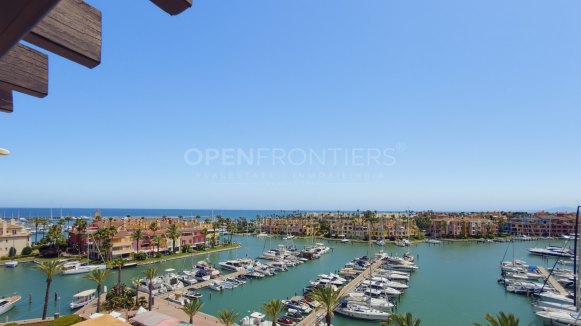
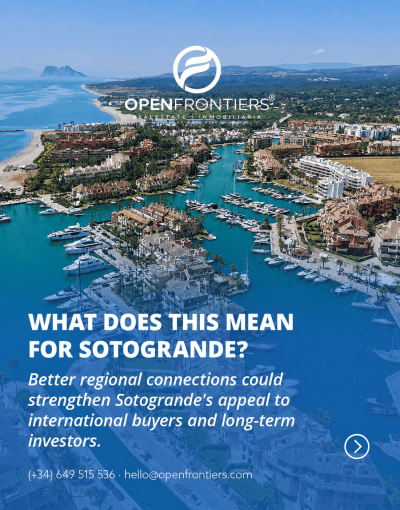
- A larger pool of potential long-term residents. Gibraltar-based professionals who previously had to ration their time in Spain, or commute in more limited ways, now have a more straightforward path to living locally full-time. Sotogrande — with its established international community, schools, and marina lifestyle — is a natural landing point for this group. If you’re exploring what’s currently available, you can browse our Sotogrande listings here.
- Reduced friction for cross-border life generally. Easier daily movement tends to make an area more attractive to remote workers, retirees, and second-home buyers who split time between Gibraltar-linked business interests and a Spanish residence.
- A longer-term, not immediate, effect. Real estate markets absorb structural changes like this gradually — through slowly increasing demand, greater buyer confidence, and improved perception of the region’s stability, rather than a sudden spike. Historically, changes to Gibraltar’s border arrangements (its 1969 closure under Franco, partial reopening in 1982, full reopening in 1985) have shown that behavioral and market adjustments play out over months and years, not days.
The Caveat That Matters
The agreement is still provisional. European Parliament consent and UK ratification are pending, and it’s reasonable to expect adjustments, clarifications, or delays as the legal process completes. Anyone making a property decision on the assumption that current arrangements are permanent and final should treat that as a working assumption, not a guarantee — and get current legal and residency advice, since individual circumstances (nationality, existing residency status, employment type) will affect how the treaty applies.
Looking Ahead

What’s certain is that a 300-year-old physical barrier no longer functions as one, and cross-border life between Gibraltar and Spain has fundamentally changed shape. What that means for Sotogrande’s property market specifically will become clearer over the next 12–24 months, as buyer behavior, rental demand, and transaction data start to reflect the new reality on the ground. We’ll be watching it closely — and will follow up with data-backed analysis as the picture develops.
If you’re thinking about how this affects your own plans in Sotogrande, it helps to talk to a team that follows this market closely — you can see some of our clients’ experiences here.
Sources: Spanish Ministry of Foreign Affairs, European Union and Cooperation (exteriores.gob.es); La Moncloa (Spanish Government); Council of the European Union; House of Commons Library research briefing CBP-10572; EFE/Reuters reporting via La Hora.