Marbella vs Sotogrande Property Prices: 2026 Data
Marbella vs Sotogrande property prices don’t compare the way the headline numbers suggest. If you’ve spent any time looking at Costa del Sol real estate data, you’ll have noticed something that doesn’t quite add up: Marbella and Benahavís post higher average prices per square metre than Sotogrande. On paper, that makes Sotogrande look like the “cheaper” option. In practice, anyone who has actually transacted in Sotogrande over the last two years knows that’s not what’s happening on the ground.
The real explanation isn’t that Sotogrande is less desirable. It’s that the two markets are built differently, sized differently, and — critically — recorded differently in the data everyone uses to make these comparisons. Here’s what the notarial statistics actually show, what they leave out, and why Sotogrande’s small size is the whole story.
The headline numbers (May 2025 – April 2026)
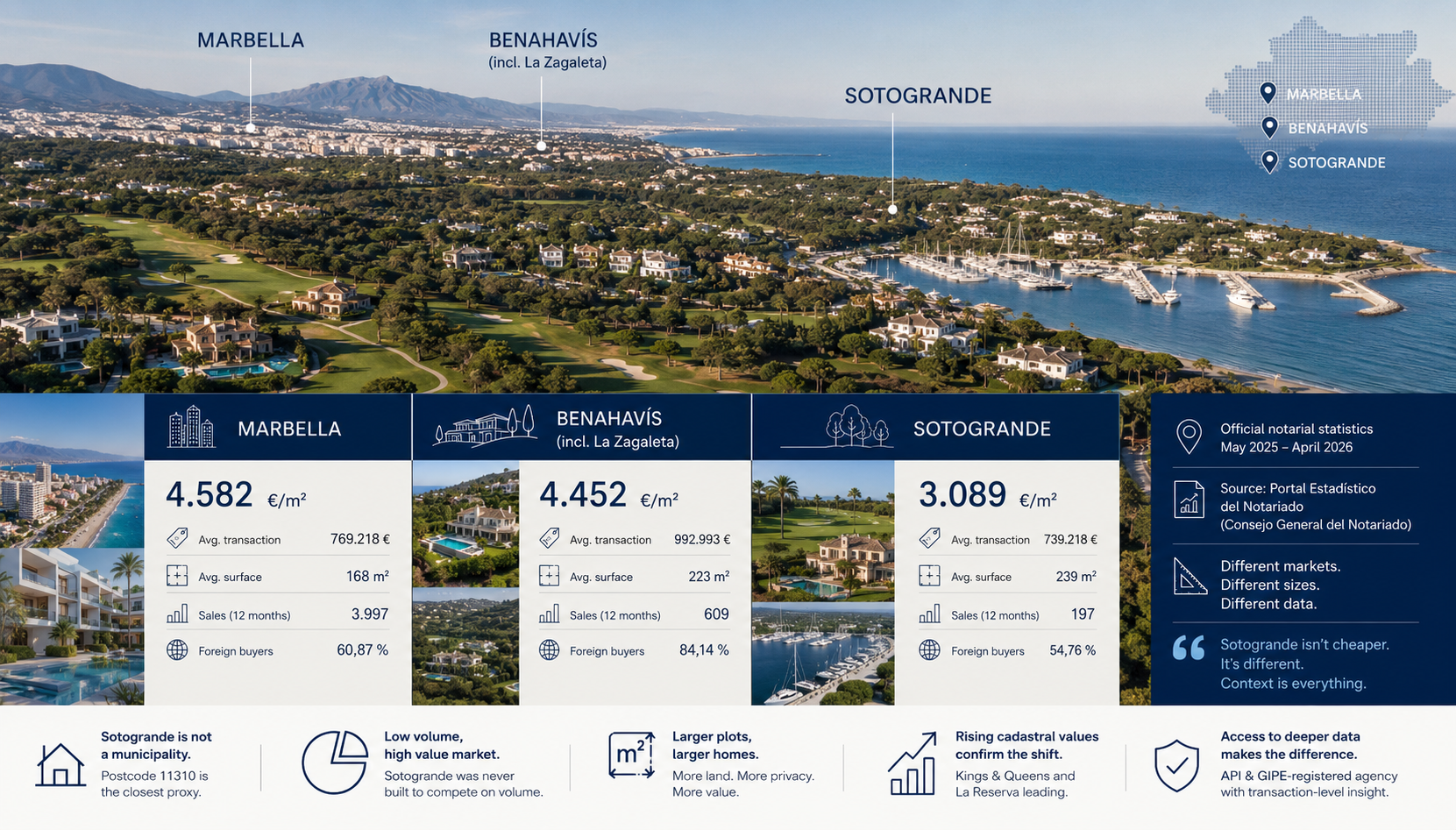
Working from Spain’s official Portal Estadístico del Notariado — the Consejo General del Notariado’s dataset of every notarised property transaction — the twelve-month picture looks like this:

At first glance, Marbella and Benahavís look like the stronger markets — higher price per square metre, more foreign demand. But three numbers in that table tell the real story: sales volume, average surface area, and the fact that Sotogrande doesn’t even have its own municipal statistics to begin with.
Why “Sotogrande” doesn’t officially exist in the data
This is the first thing to understand before drawing any conclusion from notarial data: Sotogrande is not a municipality. It’s an urbanisation that sits within the municipality of San Roque, alongside San Roque town itself, San Enrique, Torreguadiaro, Guadiaro, and other areas with very different price points — you can read more about how Sotogrande’s geography and history shaped this in our area guide. San Roque as a whole notarises at 2.984 €/m² — a figure that blends Sotogrande’s ultra-prime villa sales with considerably more modest transactions elsewhere in the municipality.
There is no official “Sotogrande” line item in Spanish notarial statistics. The closest proxy available is postcode 11310, which is what we’ve used above — and it’s a reasonably tight proxy, since 11310 covers the core Sotogrande urbanisation. But it’s still an approximation, not an exact administrative boundary, and that matters when you’re benchmarking against municipalities that do have clean, isolated reporting. You can view the underlying notarial statistics portal yourself for context.
This is also where access to deeper data tools becomes relevant. As an API and GIPE-registered agency, Open Frontiers has access to property-level and transaction-level data that goes well beyond what’s published in aggregate municipal or postcode statistics — letting us isolate Sotogrande, and specific developments within it, far more precisely than postcode data alone allows. Even so, no data source — ours included — can claim to be 100% exact for a private, low-volume, gated-community market like Sotogrande, simply because so much of what happens here either isn’t yet notarised, isn’t publicly disaggregated, or sits inside structures (off-plan, corporate vehicles, gated estates) that resist clean public reporting. We get extremely close. Nobody gets perfect.
It’s not just notarial transaction data that’s been catching up with this shift, either — rising cadastral values across Sotogrande, particularly in Kings & Queens and La Reserva, are an independent, government-side confirmation of the same underlying story: Sotogrande has moved well beyond its old reputation as “the quiet alternative to Marbella.”
Why Benahavís looks like a macro-villa market: La Zagaleta
The Benahavís numbers deserve their own explanation, because they’re skewed by one specific factor: La Zagaleta.
La Zagaleta — Europe’s most exclusive gated estate, with roughly 230-250 built villas today out of a planned 420 — sits entirely within the municipality of Benahavís, not Marbella, despite being routinely marketed and perceived as “Marbella.” Property prices inside La Zagaleta range from roughly €2M at the entry level up to €30M+, with most transactions concentrated well into eight figures. That’s a major part of why Benahavís shows the largest average transaction size of the three markets (992.993 €) and the largest average surface area (223 m²) — it isn’t a typical residential municipality, it’s a municipality whose notarial average is being pulled upward by one of the highest-value gated communities on the planet.
This is also why Benahavís posts 609 sales over twelve months against Sotogrande’s 197. Three times the volume sounds like a meaningfully bigger market — and it is — but the comparison needs context. Benahavís as a whole, including Zagaleta, El Madroñal, La Quinta, Los Flamingos and the rest, is a 145 km² municipality with a far broader and deeper inventory than Sotogrande, which remains a single, geographically constrained urbanisation. Sotogrande was never built, and was never intended, to compete on volume.
Marbella’s higher €/m²: it’s a product mix story, not a desirability story
The other comparison worth correcting is Marbella vs Sotogrande directly. Marbella notarises at 4.582 €/m², well above Sotogrande’s 3.089 €/m². The instinctive read is “Marbella is more expensive, therefore more desirable.” That’s not quite right.
Marbella’s average price per square metre is higher largely because Marbella has a deep stock of turn-key, ready-to-move product — completed apartments and villas that close at market price and get notarised promptly. 81.41% of Marbella’s notarised sales in this period were apartments, averaging just 168 m² — a different product entirely to what’s selling in Sotogrande. Marbella’s average surface area of 168 m² versus Sotogrande’s 239 m² tells you everything about what each market is actually transacting: Marbella is, in large part, an apartment market; Sotogrande is, overwhelmingly, a villa market on considerably larger plots.
Sotogrande’s notarial average is also weighed down by something Marbella’s isn’t: a meaningful share of its highest-value sales simply aren’t in the data yet, because they’re being bought off-plan, under construction, and haven’t reached notarisation. The clearest example is also the most extreme one.
Villa Niwa: Sotogrande’s record sale, and why it’s invisible in notary data
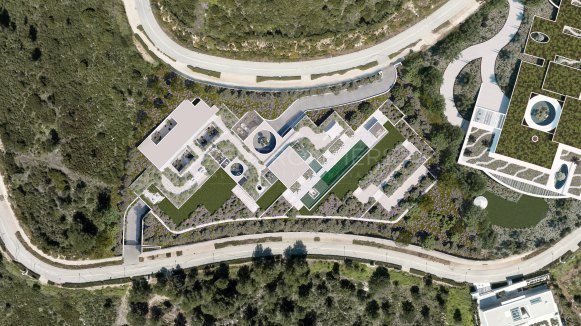
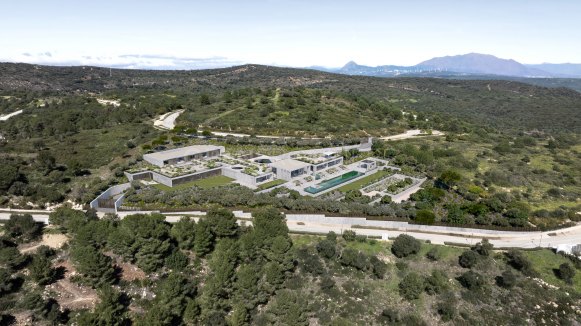
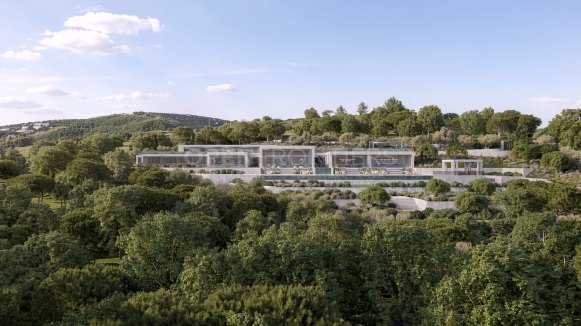
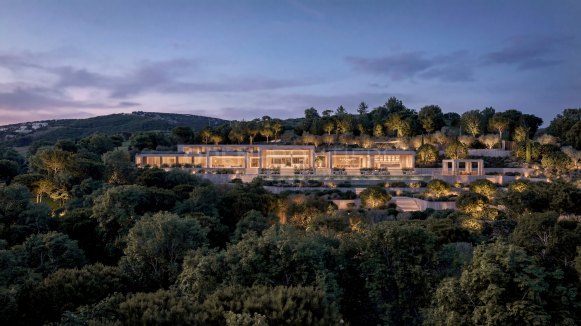
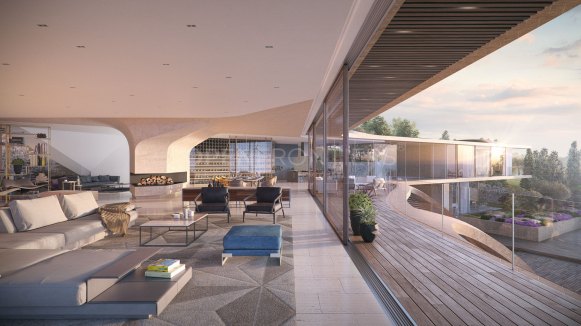
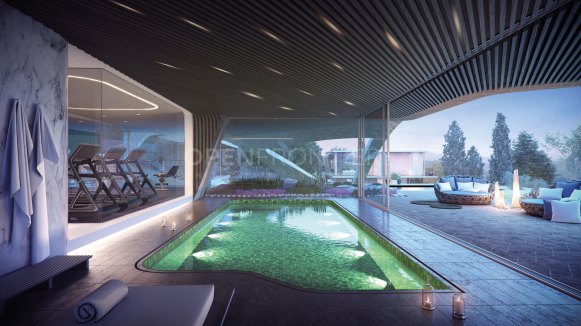
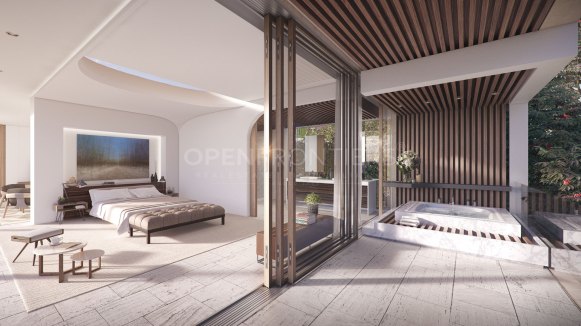
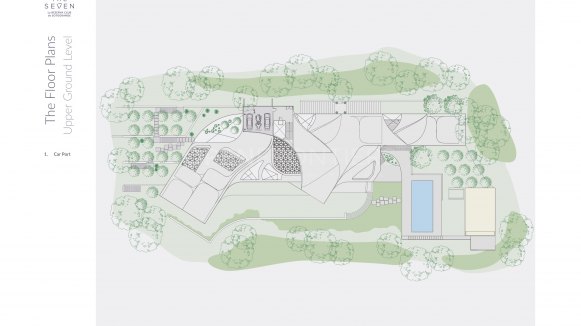
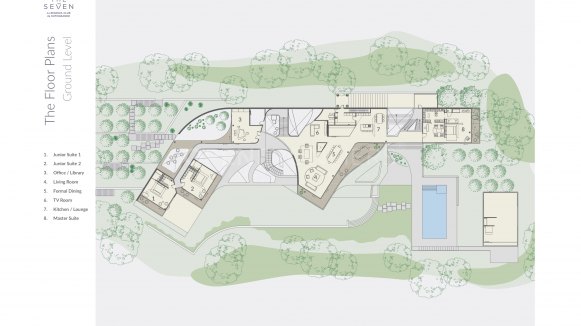
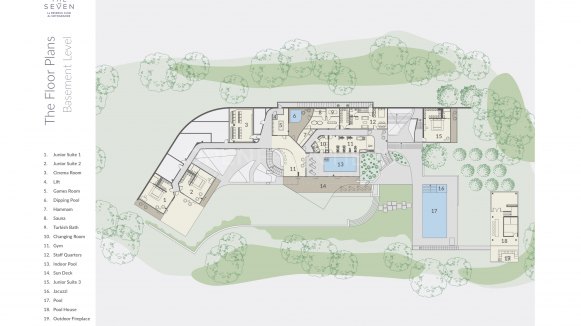
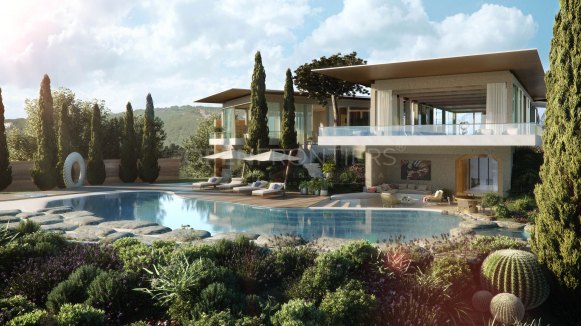
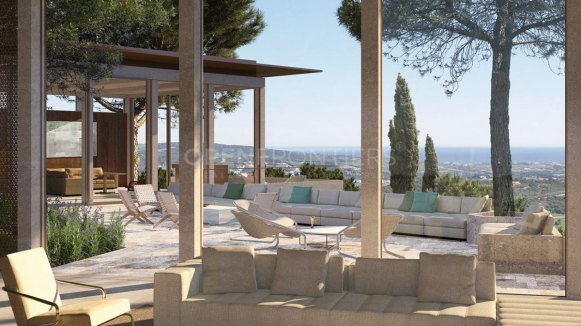
In late 2025, Villa Niwa — a 4.300 m² residence on a 10.000 m² plot within The Seven, in La Reserva — went to market at €22.5M and became the most expensive home in Sotogrande’s history. Spanish press coverage at the time confirmed the closing price at over €20M, with some reports citing figures above €22M.
What that public reporting doesn’t capture: the buyer added a substantial package of extras on top of the base purchase, which — confirmed directly with parties close to the deal — took the final transaction value to €23.750.000. None of that figure is written anywhere publicly, and it won’t appear in notarial statistics for some time, because Niwa was bought off-plan and is still under construction. The notary data this entire article is built on only captures completed, registered sales — so Sotogrande’s single biggest transaction in its history is, right now, structurally absent from the dataset everyone uses to compare these markets.
This is the core distortion to understand: Sotogrande’s true ultra-prime activity is running ahead of what the official statistics can show, while Marbella’s turn-key product gets notarised and counted in close to real time.
El Mirador: proof the resale market is only just arriving
There’s a second, more structural reason Sotogrande’s price data lags what’s actually happening, and it has to do with supply.
Marbella has had a deep, liquid resale market for ultra-prime villas for years — there’s simply enough stock for properties to change hands repeatedly, with each resale recorded and feeding into the average. Sotogrande has not had that, because until very recently, there wasn’t enough macro-villa stock to resell.
El Mirador, in La Reserva, is the clearest illustration. It’s a gated enclave of six plots, five of which were built — the first development in Sotogrande to confirm a genuine ultra-prime price point. When those five villas sold off-plan in 2020-2021, they went for between €6M and €11M, a record at the time for Sotogrande as a destination.
Those same villas are only now starting to resell — and the numbers tell their own story. Villa Vela, one of the five, came to market as a resale at an asking price of $23M (2022), was later repositioned at €17.9M, and is currently listed at €12M. Villa Aquarius, the largest of the five at 9.558 m² of plot and 1.917 m² built, has just come onto the resale market at €15.9M. That’s not a market falling off a cliff; that’s a thin, immature resale market finding its level for the first time, with very few comparable transactions to price against — and the fact that two of only five villas are now resale-listed at the same time, at prices well above the original 2020-21 off-plan range, is itself the clearest sign yet that this segment is finally maturing. Sotogrande simply hasn’t had the resale cycle Marbella has had for a decade — because the macro-villa stock to resell has only just been built, and is still being built as we speak, with much of La Reserva still to be developed.
That’s changing. The Seven and The Fifteen, both in La Reserva, are now bringing meaningfully more €10M+ villas into the market — construction in La Reserva at present is genuinely substantial — which means that over the next two years, as these villas complete and their off-plan purchases finally get notarised, this new supply should start to show up properly in the data. The resale market itself is a separate, later story: it will likely only confirm once this wave of new-build stock has actually sold and settled, which points to a few years beyond that before Sotogrande has a genuine, liquid resale market at the top tier. Until that inventory matures, Sotogrande’s average will keep looking artificially low next to Marbella’s, simply because Marbella has decades more turn-key resale stock feeding its number.
So which market is “better value”? Wrong question.
Comparing Marbella, Benahavís and Sotogrande on price per square metre treats them as substitutable products in the same market. They aren’t. This is basic supply and demand, and Sotogrande is the clean textbook case of it.
Sotogrande cannot grow. Its boundaries are fixed, its zoning is established, and there is no meaningful path to a significantly larger urbanisation footprint. When demand keeps rising against a supply base that structurally cannot expand, classical economics gives you exactly two outcomes: prices rise, or buyers look for substitutes. Sotogrande is currently showing both.
Within Sotogrande itself, the lack of available stock — particularly at the macro-villa level — is precisely why prices at the top end (Niwa, The Seven, The Fifteen) are accelerating well beyond what the notarial average shows. And because Sotogrande itself cannot absorb all of that demand, it’s spilling into the surrounding area: Alcaidesa, San Roque Club, San Enrique, and Torreguadiaro are all increasingly functioning as substitute products for buyers priced out of, or unable to find stock in, Sotogrande itself. That spillover effect is itself a signal of how constrained the core market has become — and it’s a trend worth watching closely over the next development cycle.
Marbella and Benahavís, by contrast, are not capacity-constrained in the same way. Marbella alone notarised 3.997 sales in this twelve-month window — twenty times Sotogrande’s volume. Benahavís, largely on the back of Zagaleta, notarised 609. Sotogrande’s 197 sales aren’t a sign of a weak market; they’re a sign of a market with a fundamentally smaller, slower-moving, and more constrained supply of product to sell. When you weigh up Marbella vs Sotogrande property prices on €/m² alone, without accounting for that difference in scale, product mix, and reporting lag, you get a misleading picture of all three markets — but especially of Sotogrande.
Data sources: Portal Estadístico del Notariado (Consejo General del Notariado), May 2025–April 2026, all property types. Sotogrande figures based on postcode 11310 as the closest available administrative proxy, supplemented by Open Frontiers’ direct market data as an API and GIPE-registered agency. Off-market and off-plan transaction details (Villa Niwa, current Villa Vela and Villa Aquarius pricing) confirmed directly with parties involved in the transactions, where not yet reflected in public notarial records.
Frequently Asked Questions
Is Sotogrande more expensive than Marbella?
Not in the way the headline price-per-square-metre figures suggest. Marbella’s notarised average (4.582 €/m²) is higher than Sotogrande’s (3.089 €/m²), but this reflects product mix, not desirability: Marbella sells mostly turn-key apartments averaging 168 m², while Sotogrande sells mostly large villas averaging 239 m², many still under construction and not yet notarised at their true sale price.
Why does Sotogrande have lower average property prices than Marbella in the data?
Sotogrande’s official statistics come from postcode 11310 rather than a dedicated municipality, and notarial data only captures completed, registered sales. Sotogrande’s biggest current transactions — including off-plan villas in La Reserva — are still under construction, so they’re absent from the average until they complete and notarise.
Is La Zagaleta in Marbella or Benahavís?
La Zagaleta is located entirely within the municipality of Benahavís, not Marbella, despite being widely marketed and perceived as a Marbella address. This is why Benahavís’s notarial statistics show unusually high average transaction values and surface areas relative to typical municipalities.
How many property sales happen in Sotogrande per year compared to Marbella and Benahavís?
Over the twelve months to April 2026, Sotogrande (postcode 11310) recorded 197 notarised sales, against 609 in Benahavís and 3.997 in Marbella. The difference reflects market size and supply, not demand: Sotogrande is a single, geographically constrained urbanisation, while Marbella and Benahavís are full municipalities with far deeper inventory.
Why can’t Sotogrande grow its housing supply?
Sotogrande’s boundaries and zoning were established in the 1970s, and there is no meaningful path to expanding the urbanisation’s footprint. With demand continuing to rise against a fixed supply, prices at the top of the market are increasing, and buyer demand is increasingly spilling into neighbouring areas such as Alcaidesa, San Roque Club, San Enrique, and Torreguadiaro.