The Border We Used to Build, and the One We Cross Now

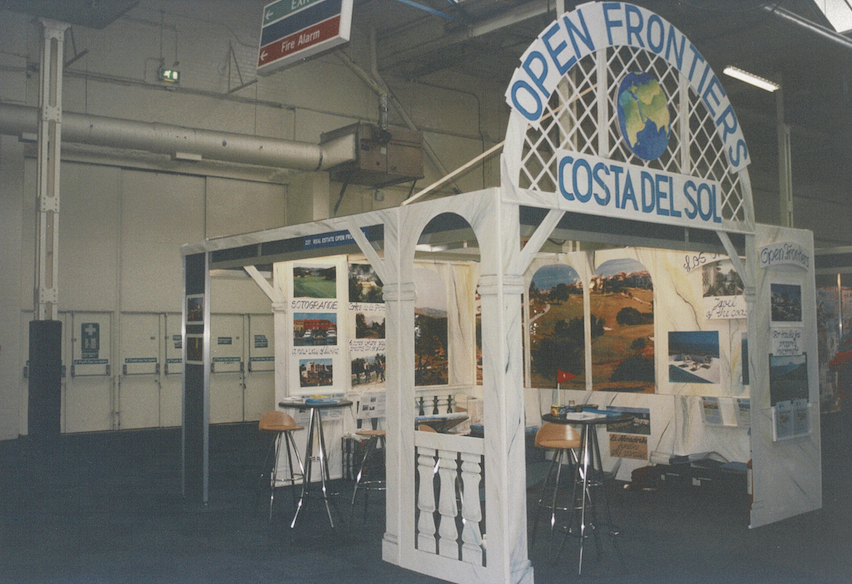
Our open frontiers real estate history starts, in a very literal sense, in a box of old photographs — we still have the pictures of the stand. A white arched frame, painted to look like marble, columns, even a little balustrade — with “Open Frontiers, Costa del Sol” arched across the top in hand-painted letters around a hand-painted globe. We built the whole thing ourselves, in Spain, and then had it shipped to London for a single event: Viva España, at Olympia, sometime around 2000 or 2001.
Viva España wasn’t a property exhibition in the usual sense. It was a full Spanish experience under one roof — flamenco, Spanish products, even horse shows — with property as just one part of a much bigger celebration of the country. That combination is, I think, exactly why it worked so well. People didn’t walk in looking for spreadsheets and floor plans. They walked in already half in love with Spain, and we simply had to show them where they could belong to it.
It was, without question, the best-organised event we’ve ever taken part in. And it became the real starting point of our success: over that one event, we sold 17 properties, almost all of them in La Duquesa and the area around it, where our office was at the time.

I still remember how busy that stand was. Looking at the photos now, there’s barely room to stand — people crowded three and four deep around the property boards, someone holding one of our yellow property flyers, someone else with a “Viva” tote bag over her shoulder. We didn’t have a big company behind us. We had a stand we’d built ourselves, a handful of photographs pinned up under handwritten labels, and a genuine belief that what we were offering — a life on the Costa del Sol — was worth crossing borders for.
From One Big Week to Years of Routine

Viva España was a one-off. What came after it wasn’t.
For years afterwards, we exhibited regularly at Second Home, the property fair that toured through Belgium and the Netherlands — Ghent and Antwerp, Utrecht and later Maastricht. Where Viva España had been a single, spectacular week, Second Home became something steadier: a rhythm of shows, year after year, where we met Belgian and Dutch buyers looking for exactly what we’d been selling since the beginning — a second home, or a whole new life, in the sun.
In 2013, we made the decision to stop. It wasn’t because the fairs stopped working. It was simply that, over time, our own price segment had moved beyond what most of the fair’s average visitors were looking for. Second Home is, and remains, an excellent event for a very wide public — it just, at that point, was no longer the right stage for us specifically. It felt more honest to step back than to keep exhibiting to an audience we weren’t the best fit for anymore.
Around 2012, we also took part in A Place in the Sun Live, in London’s ExCeL exhibition centre, as members of AIPP — the Association of International Property Professionals. It was a completely different world from that homemade stand at Olympia a decade earlier: a large, professional, long-running exhibition tied to the well-known Channel 4 television show, with an entire trade association behind us rather than a stand we’d built with our own hands.
Both experiences taught us the same thing, in different ways. People buy into a feeling before they buy into a floor plan — flamenco and horse shows and property brochures could sit side by side at Viva España and somehow make more sense together than property alone ever could. And at A Place in the Sun, we learned how to make that same feeling land at a completely different scale, among dozens of other agencies, all competing for the same buyer’s attention.
Then the Fairs Stopped Being Where People Were
For years, opening a border meant building a stand. It meant painting those marble-effect columns onto plywood, shipping the whole thing across a sea, and standing behind it for three days hoping the right people would walk past. It meant driving to Ghent, to Antwerp, to Utrecht, year after year, unpacking the same boards and starting the conversation all over again with a completely new room full of strangers. If you wanted to reach a Belgian family dreaming of Spain, or a Dutch couple weighing up a second home, you had to physically go to where they were, on a specific weekend, in a specific city.
That strategy — the one the name “Open Frontiers” was built on in 1996 — worked for a long time. And then, almost without anyone in our industry quite noticing when it happened, the internet and social media took it over almost completely.
The room full of strangers we used to travel to meet is now just online, all the time. A family in Rotterdam thinking about Spain doesn’t need to wait for the Second Home fair to come to Utrecht in March. They can watch a video of a villa in Sotogrande tonight, from their couch, in the time it used to take us to unpack a single display board.
That’s why, today, opening the border for someone looks less like a hand-painted sign at Olympia and more like a phone camera walking through a villa’s front door. We make videos for Instagram and YouTube now, for exactly the same reason we once built a stand and flew it to London: to let someone standing on the other side of a border see, as clearly as possible, what life could look like if they crossed it.
Same Instinct, Completely Different Tools
What hasn’t changed is the instinct behind it. A video walking through a kitchen with the morning light coming in, or a drone shot sweeping over the marina, does exactly the same job that flamenco and horse shows once did at Olympia: it sells the feeling first, and lets the details follow.
What has changed is the reach, and the speed. A stand at a fair reached the people who happened to walk past it that weekend. A video can reach someone in Belgium, the Netherlands, the UK, or increasingly the US, at any hour, without either of us ever booking a flight. In that sense, the internet hasn’t replaced what we used to do at those fairs — it’s simply become a far bigger, far faster version of the same idea: open a frontier, and show someone what’s on the other side of it.
If you want to see what that looks like today, you can find our property tours and lifestyle videos on our YouTube channel, including our ongoing property showcase playlist, or follow the day-to-day on Instagram, where we share a closer, more immediate look at Sotogrande life alongside the properties themselves.
It’s a strange thing, looking back at those old photographs of a stand we built with our own hands, and then opening Instagram on a phone that fits in your pocket. But the goal hasn’t moved an inch since 1996. We’re still just trying to open a frontier for someone, and show them what’s waiting for them on the other side.


