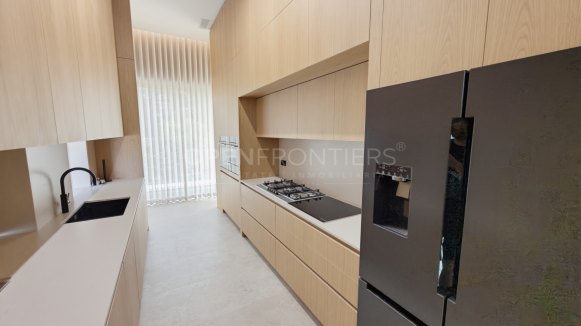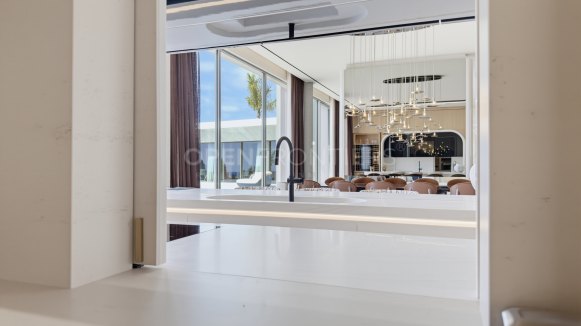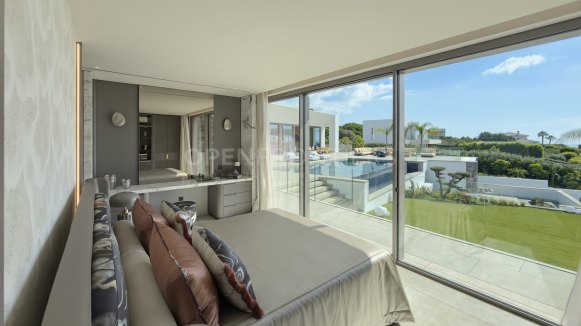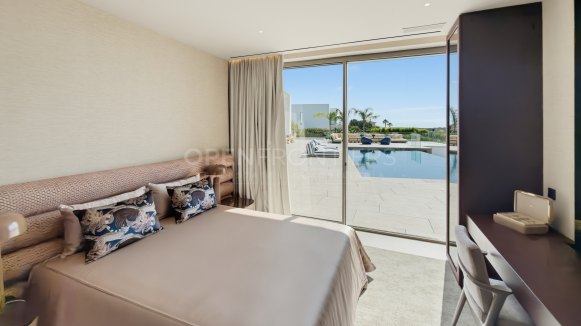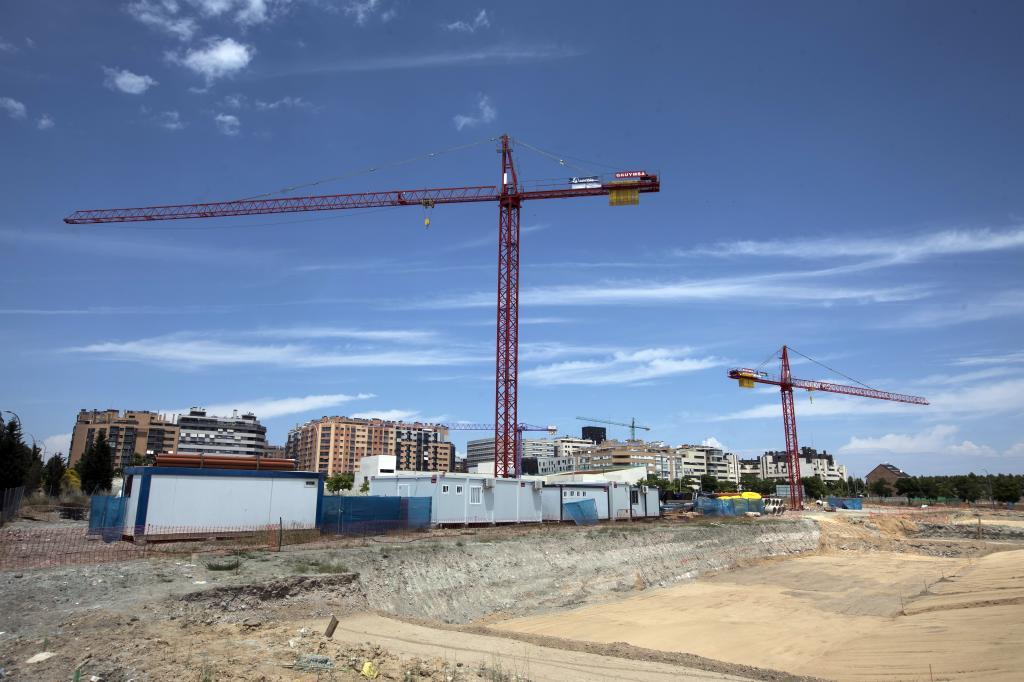
Construction Costs Are Rising. Sotogrande Isn’t Slowing Down.
Why a construction-cost shock is reshaping this market, not cooling it

Construction costs Sotogrande buyers face follow the same national trend driving up prices across Spain: construction costs are up 25% since 2019. Labor costs are climbing even faster: construction wages rose 7.5% year-on-year in the first quarter of 2026 — more than double manufacturing’s 3.6% rise, and well above the 5.3% average across the whole Spanish economy.
That doesn’t cool Sotogrande down. If anything, it’s reshaping who buys here, and why.
The Cost Floor Is Structural, Not Cyclical
A quick orientation before the numbers: everything below is national, Spain-wide data. None of it is a signal about Sotogrande specifically. Read it for the mechanism driving costs up, then see how differently this market absorbs it.
Spain’s construction cost index hit an all-time high in April 2026. The Bank of Spain has tracked this index since 2005, and it has never been this high. The cumulative increase since the index began now approaches 67%, with a 3.5% rise in the past year alone.
There’s a second national signal worth naming: construction production itself is now falling, not just costs rising. The construction production index (IPCO) fell 9.8% year-on-year in July 2026, its seventh straight month of decline, and building specifically contracted 35.2%. Read together with costs at record highs, that looks like demand destruction — at the national level, prices have started to outrun what much of the market will pay. Sotogrande is not that market. Most of its buyers are UHNWI — ultra-high-net-worth individuals — purchasing largely or entirely in cash, so they don’t pull back the way mortgage-dependent, price-sensitive buyers do when costs rise nationally. That’s the mechanism: where demand doesn’t retreat, a cost shock shows up in price, not in less building — the same logic the Paciorek study makes below, applied here.
Materials are only part of the story. Labor is the deeper problem, and it is demographic, not cyclical. Spain’s construction workforce is aging fast — the average worker’s age has climbed nearly seven years in just fifteen, and today’s average worker is over 45. One in five current workers will retire within the next decade, and very few young workers are replacing them.
Energy and fuel add another layer. A survey by CNC, Spain’s national construction confederation, found 90% of construction firms report a real cost impact from the conflict in Iran. Over 60% saw fuel costs rise more than 20% — one in four saw increases above 30%. 83% saw electricity costs climb, some by as much as 20%. ANCI (Asociación Nacional de Constructores Independientes) puts energy and material costs up 50% year-on-year in the first four months of 2026.
Spain’s national employment service, SEPE, says nearly 80% of construction vacancies are hard to fill; 18.6% go unfilled entirely, for lack of candidates. The Bank of Spain estimates Spain’s housing deficit at 750,000 units — a gap that cannot close if the workforce building new homes keeps shrinking.
None of this fixes itself quickly. A workforce doesn’t get younger, and a housing deficit doesn’t close overnight. That’s the structural cost floor under this market, not a passing spike.
Why Developers Pass the Cost Straight Through
Direct construction costs make up roughly 80% of a project’s total spend, the ACR Direct Construction Cost Index shows, and labor alone is 30–40% of that figure. When wages rise 7.5% in a single quarter, a developer cannot simply absorb it — the cost has to go somewhere, and it goes into the sale price.

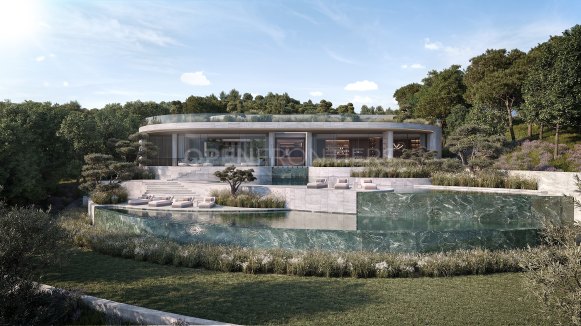
In La Reserva, that pass-through is already visible. For a buyer who already owns the plot, building today costs €4,500–5,000 per m², all-in — architect fees, licensing, and construction, plot excluded. That’s the self-build cost, not what a developer charges for a finished, turnkey home; a developer’s price adds the plot and their margin on top.
There’s a second signal here, and it’s more telling than the first. A year ago, homes in “the fifteen,” in La Reserva, were closing at about €4,500 per m². The latest launch holds the same headline price, €12–14 million, but delivers less built area than before. Price per m² is rising sharply, even though the sticker price looks unchanged.
This is a recognizable pattern, not unique to any one developer. Buyers anchor on a familiar price bracket, set by earlier sales in the same development. Developers work within that anchor and adjust the product instead of raising the sticker price, as building costs climb.
Headline price is what jumps out when scrolling listings. Price per m² takes real digging and deeper analysis to compare. That’s why this trend is easy to miss unless you’re already tracking it closely. Track €/m² directly, and the pattern is clear.
Why Existing Homes Are a More Attractive Buy Right Now
Here is the effect that matters most for today’s buyer: existing homes have suddenly become far more attractive.

A real example, on the market right now: a villa in La Reserva. It is listed at €3.7 million, with 1,000m² built.
Compare that to €4,500–5,000 per m² for new construction when doing it yourself and already owning the plot. Buying and renovating is cheaper than building from scratch, even today.
This gap exists because pricing for existing homes lags behind replacement cost. Sellers and appraisers benchmark against recent comparable sales, which is a backward-looking number by definition. Replacement cost is moving in real time, and comparable-sales pricing simply hasn’t caught up. For now, that lag is the opportunity.
It will not stay a mismatch for long. Many buyers today want a fully turnkey home, not a renovation project. As new-build €/m² keeps climbing, that pressure spills into existing, move-in-ready homes too. Right now, existing stock has not repriced yet, and most of the market has not registered the new-build cost increase either. That combination is what creates today’s window.
Where the Renovation Opportunity Actually Sits, Zone by Zone
Not every part of Sotogrande offers the same renovation opportunity. Location changes the math.
Sotogrande Costa (Zones A and B). Price per m² is already high here. Renovation economics still work, but they don’t leave much room for error. A successful reform demands precise, well-negotiated buying, with no margin for surprises once the work is underway. Miscalculate the entry price, or the reform budget, and the final cost overtakes market value.
Within Costa, Kings and Queens sits in a category of its own. Stock is scarce and prices are already premium, so even the entry point demands serious capital — high enough that many promoters won’t take on that risk. For a private buyer, though, total spend on a Kings and Queens reform can land close to an off-plan purchase in La Reserva: a complete, turnkey new build, with none of the reform headache. Unless the location itself is non-negotiable, the math tends to favor the La Reserva stock at those price points.
Sotogrande Alto. This offers a more straightforward opportunity right now. Zones F and C stand out in particular, with E and D also showing genuinely promising properties. Lower entry prices leave more room between purchase cost and turnkey value — a cushion that matters more now that reform costs are climbing too.
La Reserva. This is where the action is on the new-build side. Construction-cost inflation shows up there first, launch after launch.
This Is Not a Cooling Market

A rising price per m² does not automatically signal a weaker market. In a market with capped supply, it works the other way around.
When supply cannot expand, demand pressure has only one place to go: price. A 2012 Federal Reserve study, by economist Andrew Paciorek, demonstrated exactly this — comparing San Francisco, where land is scarce, to Atlanta, where it is not. Facing identical demand shocks, San Francisco’s price volatility was roughly double Atlanta’s.
The reason is supply elasticity: how much new housing a market can add as prices rise. Constrained markets showed an elasticity near 1.7; open markets showed 2.8. Put simply, an unconstrained market can build its way out of a price shock, and a constrained one can’t.
Sotogrande falls into that second category. Its geography sets a hard limit on how much it can grow, and that’s not a marketing line — it’s a supply constraint working exactly the way the Fed paper describes.
This is the real difference with Marbella. Marbella keeps expanding — into Zagaleta, up into the hills, further down the coast — wherever land allows. Sotogrande does not, and cannot. It sits inside a fixed footprint, closed in by the coastline and the estates that define it. Other developments borrow the name or try to copy the model; none of them is Sotogrande. There is no second one to build. That is the finite-supply case the Fed paper describes, in physical form.
None of this is just theory. It shows up in the numbers below.
CaixaBank Research places Spain among the advanced economies with the most acute housing shortages. Knight Frank’s 2026 Wealth Report confirms the same pattern in the prime segment specifically, and names Marbella directly as a resilient, multi-generational family destination.
Prime real estate resists downturns for another reason: look at who’s buying it. The global population of ultra-high-net-worth individuals keeps growing, and family offices now put a meaningful share of their portfolios into real estate — for European UHNW households, that can run 25 to 40% of net worth. That kind of capital doesn’t move much with interest-rate cycles. It’s chasing scarcity and capital preservation, not a quick return.
Sotogrande has been through this pattern before. In 2023 and 2024, the market took time to confirm a new price level; once it did, prices accelerated. Real estate moves slowly, by nature, and the broader market always lags behind what the numbers already show.
Each cycle of buyers arrives with more purchasing power than the last — that’s what keeps repricing the market upward, and why a few years ago’s entry point no longer holds.
What’s changing isn’t demand for Sotogrande. It’s who the market rewards. A year ago, plenty of buyers were building to profit from development; that calculation has gotten riskier over the last six months. Building makes more sense now for the person who’s actually going to live in the house, and less for anyone hoping to flip it fast.
Call it what it actually is: not a market losing steam, but one changing hands.
Where Open Frontiers Fits In
These numbers move month to month. Our job is to turn them into decisions, for each buyer and each seller.
If you are buying, we compare renovation and new build using real figures, not estimates. If you are selling, we price against today’s market, not last year’s.
Sotogrande doesn’t need superlatives to make its case. It needs someone who actually knows the numbers and can explain them plainly.
Frequently Asked Questions
Are construction costs rising in Sotogrande?
Yes, in step with the rest of Spain. National construction costs are up 25% since 2019, and the Bank of Spain’s construction cost index hit an all-time high in April 2026. Sotogrande faces the same national cost pressures as everywhere else in the country.
Will rising construction costs slow down the Sotogrande market?
No. Sotogrande’s geography is fixed, so it cannot add supply to absorb a cost shock — the pressure shows up as price, not as a slowdown. Most buyers here are UHNWI, purchasing largely or entirely in cash, so they don’t pull back the way price-sensitive buyers do nationally.
Is it cheaper to renovate or build new in Sotogrande right now?
Generally, yes. A real La Reserva example: a villa listed at €3.7 million with 1,000m² built works out to roughly €4,070/m², plot included, against €4,500–5,000/m² to self-build today. That gap won’t last — new-build costs are already spilling into existing-stock pricing.
Which zone in Sotogrande has the best renovation opportunity right now?
Sotogrande Alto, particularly zones F and C, with E and D also showing promising properties. Lower entry prices there leave more cushion between purchase cost and turnkey value. Sotogrande Costa (Zones A and B) still works, but needs precise, well-negotiated buying with no room for error.
Why are new-build prices in La Reserva rising even when the headline price looks the same?
Developers are holding familiar price brackets from earlier launches and shrinking the built area instead of raising the sticker price. The result: price per m² is climbing sharply even though the advertised price looks unchanged.
What’s actually driving construction costs up in Spain?
Two structural forces: a demographic labor shortage — the construction workforce is aging fast, with few young workers replacing retirees — and higher energy and material costs, which a CNC survey ties largely to the conflict in Iran. Neither is a short-term spike.
Sources
- Idealista — “La crisis de mano de obra en el ladrillo se acelera”, Sep 2026
- Idealista — “El índice de los costes de construcción marca máximos históricos”, Jun 2026
- que.es — “El coste de construcción de vivienda sube un 25%”, Jul 2026
- brainsre.news — Construction labor cost, Q1 2026
- CaixaBank Research — Home price resilience and supply shortages
- Federal Reserve — Paciorek, “Supply Constraints and Housing Market Dynamics” (2012)
- Knight Frank — The Wealth Report / PIRI 100, 2026
- Victaura — The Resilience of Prime Property
- Idealista — La producción del sector de la construcción cae casi un 10% en julio, Sep 2026
- Idealista — “Sin trabajadores no hay vivienda barata” (ACR direct cost index), Feb 2026