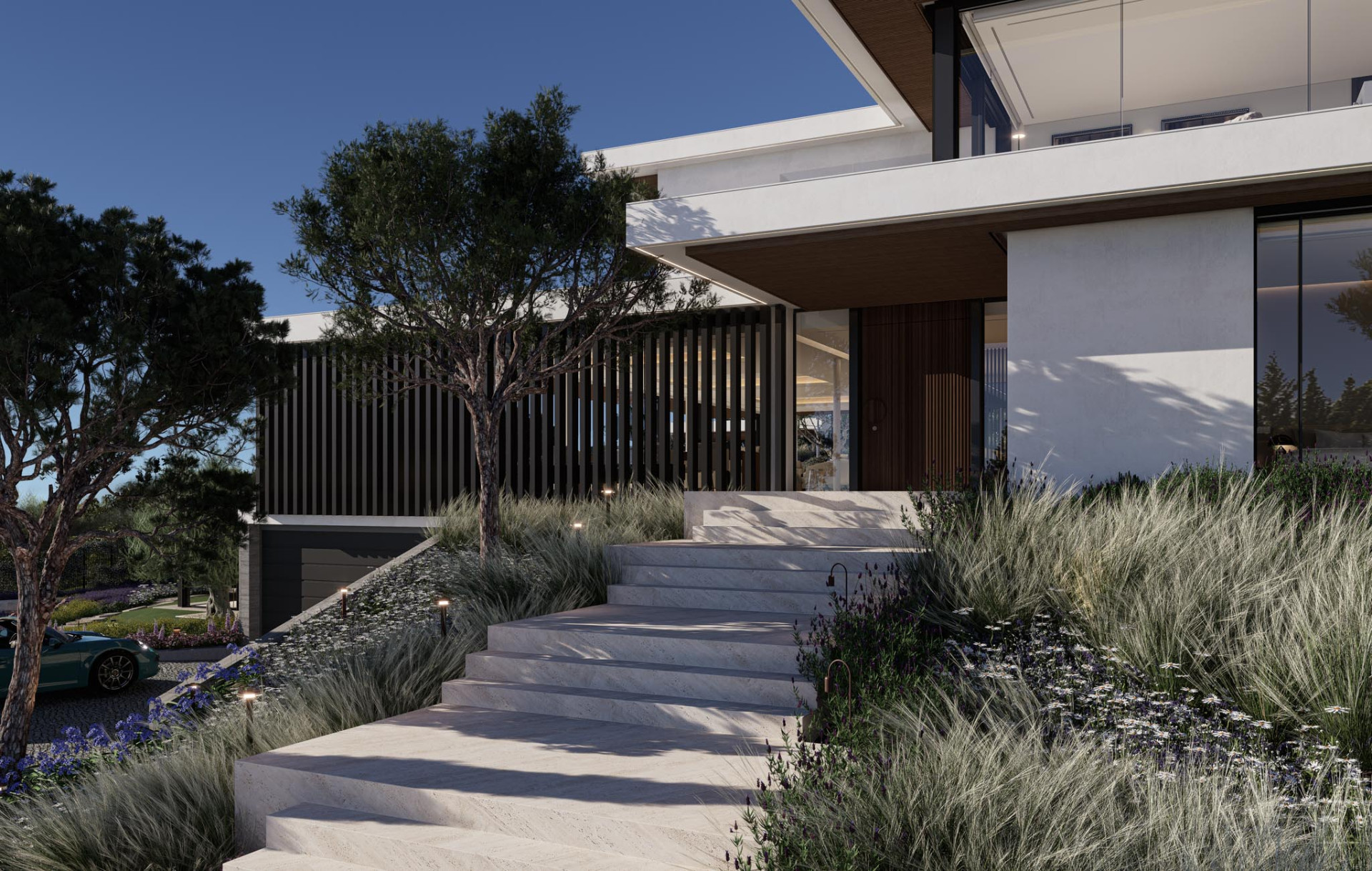
Sustainable Property: What Is Changing Around the World and What It Means for a Home in Sotogrande

From the World to a Villa
Sustainable building is no longer a niche. According to the 2025–2026 report by the UN and the Global Alliance for Buildings and Construction, the buildings and construction sector accounts for 37% of global emissions, 28% of energy consumption and almost half of all material extraction. It is worth being precise: this is the sector as a whole, not just homes. It covers how buildings are used, but also the manufacture of materials and the construction itself. And in 2024, emissions from the use of buildings rose by 1%, to 9.9 gigatonnes of CO₂.
Embodied emissions, those linked to making materials and to building, matter too: a home has an environmental impact before anyone has even moved in. The same report stresses that acting on buildings can cut energy bills and improve daily life, but also strengthen resilience to climate impacts. That second message matters most in a place like this.
This report walks through the trends changing how homes are built and run, and brings them down to what matters for owners, developers and buyers in Sotogrande: what is already used here, what is missing and what may come. It is the companion to our report on the energy certificate, which explains the rating, the rules and the obligations. This one goes beyond the letter: it explains what lies behind it.
The SDGs That Connect Most With a Home

The Sustainable Development Goals are the 17 goals the UN adopted in 2015 as part of the 2030 Agenda. This report draws on the ones that connect most closely with a home.
| SDG | How it appears in this report |
|---|---|
| SDG 6: Clean water and sanitation | Water reuse and efficient irrigation |
| SDG 7: Affordable and clean energy | Solar, storage and energy management |
| SDG 11: Sustainable cities and communities | Resilient homes, renovation and responsible construction |
| SDG 12: Responsible consumption and production | Low-carbon materials, circularity and bioplastics |
| SDG 13: Climate action | Operational and embodied emissions, and adapting to heat |
| SDG 15: Life on land | Biodiversity, cork oak woodlands and landscaping |
In a secondary way, we also touch on SDG 9 (innovation, with AI and industrialised construction), SDG 3 (health and well-being, through thermal comfort) and SDG 17 (partnerships, because almost none of this is solved alone).
Five Trends Changing How We Build

1. Smart Energy: The Home That Manages Its Own Energy (SDG 7 and 13)
The combination taking hold is to generate (solar), store (batteries), use better (heat pump and insulation) and manage everything with digital control. The rules are pushing in that direction. Article 10 of Directive (EU) 2024/1275 sets a framework for rolling out solar installations in buildings, with progressive obligations depending on building type and calendar. For new residential buildings, it provides for their application by 31 December 2029 at the latest, where technically, economically and functionally feasible, as summarised by the European Parliament.
In Spain, Royal Decree-Law 7/2026 introduced a personal income tax (IRPF) deduction for renewable self-consumption electricity installations carried out, completed and paid for during 2026. It is a specific measure, with requirements different from those of the energy-efficiency works deductions we explain in our report on the certificate, and a signal of where regulation is heading: not just generating, but storing and managing. The deduction is 10% for installations on a property owned by the taxpayer and 20% for installations in homes within predominantly residential buildings, with a maximum annual base of €5,000. The investment can include equipment, materials, installation and storage systems, provided the payment, permit (including, where applicable, the Electrical Installation Certificate) and documentation requirements are met. There are incompatibilities with certain other aid and deductions, so it is worth checking the applicable conditions before making an investment decision.
2. Artificial Intelligence: A Real Promise, but More Modest Than Advertised (SDG 7, 9 and 13)
Applying AI to heating and cooling management is one of the routes with the most potential. The American Council for an Energy-Efficient Economy (ACEEE) describes in a November 2025 report how AI can optimise climate-control systems and bring flexibility to the grid. But three types of figures should not be mixed, because they are not comparable with one another:
- What has been observed in the field. A review published in Applied Energy in December 2025 analysed 104 real demonstrations of advanced heating and cooling control, 24 in homes and 80 in commercial buildings. Its authors conclude that 71% use protocols that may give unreliable estimates. In the 29% they consider reliable, the average cost saving, weighted by the duration of the experiments, is 16% in homes and 13% in commercial buildings.
- The estimated potential. An academic review puts the potential at up to 37% in offices and up to 23% in homes. These are estimates of what could be achieved, not usual savings.
- What manufacturers advertise. Schneider Electric published a study, based on models and checked against pilots, according to which AI can cut a building’s total consumption by up to 22% compared with traditional control.
The conclusion: AI can save, but the observed results are lower than the best cases, and they are measured in costs rather than energy. For a villa, the first step is not AI: it is measuring consumption properly and fixing inefficiencies.
3. Low-Carbon Materials: Structural Timber, Cork and Renovation (SDG 11, 12 and 13)
Embodied emissions are a significant part of a building’s impact, so materials matter. Two alternatives have backing.
Structural timber. A life-cycle analysis of cross-laminated and glue-laminated timber buildings found that their embodied emissions were between 22% and 50% lower than those of equivalent concrete buildings, depending on region and height. The advantage only exists if the timber comes from well-managed forests, and concrete and steel will still be needed.
Cork. A carbon footprint study published in the Journal of Cleaner Production analysed an expanded cork insulation board made in Portugal and found a footprint of −116 kg of CO₂ equivalent per cubic metre. It is a “cradle to factory gate” analysis: it runs up to the product leaving the plant and does not include later stages, and the result depends on the product, its manufacturing process and the limits considered. According to the manufacturer Amorim’s documentation, the thermal conductivity of its boards is between 0.036 and 0.040 W/mK, in the range of synthetic insulation, although specific products should always be compared. Portugal produces more than half of the world’s cork, and Spain is the second producer, according to industry sources. For an area of cork oaks like this one, it is a material that connects with the land.
Renovation and circularity. Sustainability is not only about building with better materials: it is also about making better use of what already exists, an idea useful both for owners of existing villas and for developers. It means keeping and renovating structures where viable, avoiding unnecessary demolition and replacement, designing so that repair and maintenance are easy, and reducing construction waste and reusing materials where technically and legally possible. With almost half of the world’s material extraction linked to the sector, it is one of the routes with the most impact.
For someone who already owns a home, the approach changes. In an existing home, the first question is not always which technology to add, but what can be kept, improved and made use of before replacing it. Renovating the envelope, the windows or the systems can cut consumption without starting from scratch.
4. Bioplastics and Bio-Based Materials: Less Than the Headline Suggests (SDG 12)
Bioplastics are in every conversation, and it helps to put numbers on them. According to European Bioplastics, the production capacity of bio-based plastics is equivalent to about 0.5% of the 431 million tonnes of plastic produced worldwide each year. That capacity is expected to double from 2.31 million tonnes in 2025 to around 4.69 million in 2030. Packaging is their main application segment, with 41.3% of capacity. It is worth remembering that “bioplastic” covers different categories, such as bio-based and biodegradable materials, which are not necessarily the same thing.
In construction, their role today is a niche one. What does have a future are natural materials such as timber and cork. The practical rule for a buyer or a developer: when you hear the promise of an “eco-friendly material”, ask for the product’s environmental documentation and do not settle for the adjective.
5. Passive Design and Climate Resilience (SDG 3, 11 and 13)
One of the most established strategies is also one of the most relevant for a home in the Mediterranean: designing the house so that it needs less energy and keeps comfortable indoor conditions. Orientation, shade, insulation, windows and ventilation influence both consumption and the stability of indoor temperature and the risk of overheating during the hottest months. In a Mediterranean villa, they can be as important as the equipment installed afterwards.
The Passivhaus standard offers a technical framework for reducing energy needs and keeping indoor comfort. In Andalucía there are certified homes, such as Villa Suasana, in Mijas, and the house in Herrera, in Seville, which show that these principles can also be applied in warm climates.
Climate adaptation goes beyond energy efficiency: a passive house and a resilient house are related concepts, but not equivalent. For a home in Sotogrande, there are four criteria worth weighing:
- Shade and solar control: orientation, overhangs, shutters, pergolas and well-placed vegetation.
- Thermal comfort without relying so heavily on air conditioning: insulation, ventilation and envelope design.
- Landscaping adapted to the climate: Mediterranean species, lower irrigation needs, keeping existing trees and designing the garden to support local wildlife.
- Property resilience: looking at exposure to flooding, fire and other site-specific risks, as appropriate.
The practical idea for owners and developers is simple: many of the decisions that most influence comfort and consumption are made at the design stage. Building them in from the start is usually easier than correcting them once the home is built.
Case Studies: From the World to Sotogrande
Each case has a different role: the first two show what materials make possible, the third shows that passive solutions exist in Andalucía, and the last two are the most direct local link.
Case 1: Mjøstårnet, Norway

An 85.4-metre building with apartments, offices and a hotel, built with structural timber, which when completed in 2019 was the tallest timber building in the world. It shows that timber can support buildings far taller than was thought. For a villa it is not a direct model, but it is proof of how far the material can go.
Case 2: The Cork House, United Kingdom

The Cork House is an experimental building made with a system of solid expanded cork and timber blocks, developed from a research project. According to the project’s documentation, the building stores atmospheric carbon in its plant-based components and is carbon negative at the moment the construction is completed, with a very low life-cycle footprint according to the project’s own calculation. It is an example of how a local material from Mediterranean countries can become the basis of an entire building.
Case 3: Two Passive Houses in Andalucía
The Passivhaus standard is also applied in the south of Spain:
- Villa Suasana, in Mijas (Málaga): a single-family home that received Passivhaus Premium certification in 2021 and which, according to the Passivhaus Building Platform, is the first building to reach that category in Andalucía. It incorporates photovoltaic tiles and panels and, according to that information, produces more energy than it consumes.

- The house in Herrera (Seville): a single-family home built between 2014 and 2016, the first Passivhaus-certified building in the province, described in its project documentation as a low-tech passive house in one of the hottest places in Europe. Its heating demand is 13 kWh per square metre per year.

They are two examples of how Passivhaus principles can be applied in the warm climates of southern Spain.
Case 4: Water on the Golf Courses of Sotogrande (SDG 6, 7 and 15)

The most direct local link comes from the golf courses, and the data comes from the clubs themselves and from tournament coverage. Real Club Valderrama has, according to the club, held Audubon International’s environmental certification since the mid-1990s. In 2016 it installed an irrigation system with which, according to the club, it achieved a 19% saving in irrigation water. Later it built a lake to collect rainwater and drainage from the course and use it as irrigation water, and a team of experts monitors the course’s wildlife species and habitats.
Real Club de Golf Sotogrande irrigates, according to its management in a 2023 note, with reclaimed water from the urbanisation’s treatment plant, which means, in the club’s words, complete reuse of the water and avoids discharging it to the sea. The environmental impact study of the course’s restoration quantified a 20% saving in water consumption as a result of the set of measures applied. The club is also installing solar panels to gradually replace its machinery with electric equipment, and holds GEO certification, specific to golf courses.
The two figures have different bases: one corresponds to an irrigation system and the other to a restoration. They are not compared with each other. They show that, in this area, reusing water and caring for the environment are not new ideas.
Case 5: Two Luxury Villas in La Reserva (SDG 7, 11 and 13)
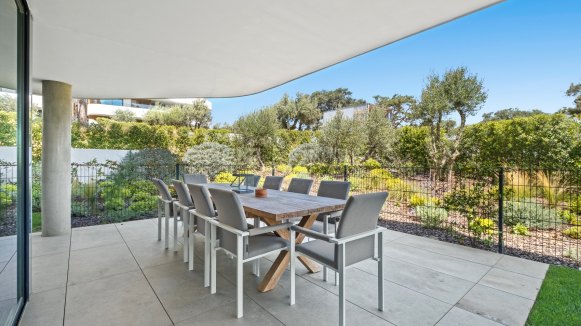
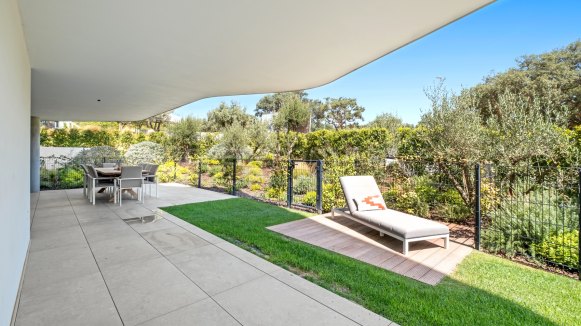
Sustainability is also entering the design of Sotogrande’s luxury villas. Two examples in La Reserva start from different approaches. The information comes from the developers themselves.
- Villa Halo. According to Cork Oak Mansion, the DUS Desarrollos brand, the villa, designed by Fran Silvestre Arquitectos and facing the golf course, is conceived with zero energy consumption as a principle. It integrates geothermal heating, solar panels and battery storage to run on renewable energy, and its stepped design makes use of natural light. On its sustainability page, the developer also describes, for its villas, rainwater collection in cisterns, greywater recycling and sensors that monitor consumption. It is an approach that builds the zero-consumption goal mainly on renewable technology.

- Villa VIDA. According to Sotogrande S.A., the villa, by ARK Architects and located in The 15, within La Gran Reserva, has been developed with bioarchitecture principles. It is designed to keep a stable indoor climate, around 21 °C throughout the year, without conventional air conditioning, relying on thermal balance, natural ventilation and solar orientation. It also incorporates natural shade, daylight optimisation and high-efficiency lighting, and a home-automation system that manages lighting, temperature and security. It is an approach that starts from bioclimatic design and not only from systems.

They are two ways of applying sustainability to a villa in the same setting. To assess them, it is worth distinguishing between the performance planned in the project and the consumption measured once the home is in use.
What Is Already Used in Sotogrande Homes
In the new-build listings we have reviewed, in Sotogrande Alto and Costa, solutions such as aerothermal heating for hot water and heating, underfloor heating and photovoltaic panels for self-consumption appear frequently. Some projects add heat-recovery ventilation, an A energy rating or gardens with native planting. Others only leave the panels pre-installed, so the generation is added by the buyer later. It is worth always distinguishing between installed equipment, pre-installed equipment and features advertised without technical documentation.
Seeing an installation advertised is not the same as knowing a home’s real performance. To assess it, it is not enough to check what equipment it includes: it is also worth knowing its performance, real consumption, maintenance conditions and the warranties on the systems. Two homes with similar advertised features can behave very differently.

What May Come
Based on what is already seen, these are the opportunities for a home in each trend.
| Trend | What is already seen | Opportunity for a home |
|---|---|---|
| Smart energy | Aerothermal and photovoltaic in new builds; geothermal and batteries in luxury villas, according to their developers | Install the generation, not just pre-install it, and consider storage |
| AI and management | Home automation in luxury villas | Start by measuring consumption |
| Materials and circularity | Little documented | Renovation and reuse of materials; cork and timber with environmental documentation |
| Passive design and climate | Certified cases in Andalucía; bioarchitecture in La Reserva, according to its developer | Build in solar protection, insulation and adaptation to the site’s climate risks from the design stage |
| Water | Reuse on the golf courses; cisterns and greywater in luxury villas, according to their developer | Water saving and reuse at the scale of a home, as the rules allow |
| Biodiversity | Wildlife monitoring in the clubs | Keep existing trees and choose Mediterranean species that help local wildlife and reduce irrigation |
What to Do
If you own a home:
- Start by knowing your real consumption and your rating, which we explain in our report on the energy certificate.
- Prioritise the passive and what already exists: keep and improve the envelope, the shade and the windows before replacing or adding technology.
- Review the water and the garden: planting, irrigation and the pool.
If you build or develop:
- Install the generation, do not just prepare for it, and think about storage.
- Design with passive and climate criteria from the start, as the certified homes in Andalucía do.
- Renovate before demolishing where viable, and ask for environmental documentation of the materials.
- Assess water-saving and reuse solutions suited to the home and to the applicable rules.
If you are thinking of buying:
- Ask what is installed and what is only pre-installed, and how it performs in practice.
- Ask about the water, the landscaping and the site’s risks, which are long-term costs and exposures.
- Ask for the documentation: the energy certificate, real energy bills and the warranties on the equipment.
Frequently Asked Questions
What is sustainable property?
A home that reduces its energy and water use, uses lower-impact materials and adapts to the climate. It is not limited to solar panels or to the energy certificate rating.
Is artificial intelligence useful for saving energy at home?
It can help optimise heating and cooling, but the results depend on the building, the control system and the quality of the measurements. In a home, the first step is to know the consumption and fix the inefficiencies.
Are bioplastics an alternative for building?
For now, their role in construction is limited. For a home, it is more useful to assess specific materials, such as timber or cork, based on their environmental documentation and performance.
Can passive houses be built in the south of Spain?
Yes. There are Passivhaus-certified homes in Mijas and Seville.
What is being done in Sotogrande to save water?
The two golf courses cited reuse or collect water: Valderrama with an irrigation system and a collection lake, and Real Club de Golf Sotogrande with reclaimed water from the treatment plant.
Is Your Property Ready for What Comes Next?
The trends changing how we build do not replace the location, the architecture or the lifestyle that make Sotogrande so special. But knowing them helps you make better decisions about a property.
Open Frontiers has known the Sotogrande property market since 1996. If you are an owner, weighing a purchase or planning a project, we would be glad to help you understand the market and weigh your options. Get in touch with our team. You can also browse our properties for sale and our new developments.

Keep Reading
- The Sotogrande Energy Certificate: What Your Rating Means and Why It Will Matter More
- New Developments in Sotogrande: From Village Verde to Ribera del Astra
- Construction Costs Are Rising. Sotogrande Isn’t Slowing Down.
About the Author
Innin Buyl is Director of Sales at Open Frontiers, the Sotogrande agency founded by her father, Ben Buyl, in 1996. She grew up in Sotogrande, a story she tells in Thirty Years of Open Frontiers.
Methodology and Sources
Global data: UN Environment Programme and GlobalABC, 2025–2026 edition, European Bioplastics and ACEEE.
Artificial intelligence: Applied Energy review (2025), academic review of management systems and Schneider Electric study.
Materials: life-cycle analysis of structural timber, cork carbon footprint, Amorim documentation and Cork House.
Cases in Andalucía and Sotogrande: Villa Suasana, house in Herrera, Real Club Valderrama, Real Club de Golf Sotogrande, Villa Halo, Cork Oak Mansion sustainability and Villa VIDA.
Legislation: Directive (EU) 2024/1275, European Parliament summary and 2026 tax changes (Spanish Tax Agency).
All figures state their period. This report is for information only. It is not legal, tax or financial advice.