Sotogrande, 1963–2026: What Sixty Years of Property Cycles Teach Buyers and Sellers Today
Updated November 2026
Most people see Sotogrande as a map of prestige: Kings and Queens at the top, La Reserva as the new frontier, the Marina for those who want to lock up and leave. That map is accurate, but it doesn’t explain why each part of Sotogrande looks the way it does. The answer is history. Almost every zone, plot size and price band here was shaped by the external market conditions it was launched into. A recession produced smaller plots. A reopened border produced bigger ones. A developer in a hurry sold land in bulk, and a whole district stood empty for a decade.
This article tells that story from 1963 to today, drawing on public records, our own archive and the deals we have worked on. It ends with what that history means for anyone buying or selling here now. We don’t forecast prices. History doesn’t repeat itself exactly, but in Sotogrande it tends to rhyme, and knowing it makes you a better buyer and a calmer seller. If you are new to the area, our guide to Sotogrande’s areas is a useful companion to what follows.
1963–1975: A private resort, built for friends
Sotogrande was the idea of Joseph McMicking and his wife, Mercedes Zobel, of the Philippine Zobel de Ayala family. McMicking sent Freddy Melian to Spain to look for land, and Melian found it here: a river, cork oak woodland and Gibraltar close by. It was the right setting for an international resort, and the estate eventually covered 1,800 hectares. The Cucurucho Beach Club was built at the same time. Its land still belongs to Sotogrande, although the club itself is now leased out.

Development began in 1964 with the Real Club de Golf Sotogrande, designed by Robert Trent Jones as his first course in Europe. (We tell that part of the story in more detail in our history of golf in Sotogrande.) The first houses went up around the course, on streets named after Spanish kings and queens such as Fernando el Santo, Felipe Segundo and Isabel la Católica. That is where the name Kings and Queens comes from, and it is still the reference address in Sotogrande Costa today.
The first buyers didn’t come through advertising. They were friends and contacts of the McMicking and Zobel families, among them the Sainz de Vicuña family and George Moore, and they gave Sotogrande the family character it still has. Prospective buyers stayed at the Golf Hotel, a small hotel of eight or nine suites for families with children over 16, which existed mainly to host viewing trips. The developer, Sotogrande Financiera, ran its sales office from Paniagua, the old farmhouse that became the centre of resort life.
The early 1970s added a second layer. The Tennis Hotel, now El Encinar, catered for families with younger children, and Sotogrande Financiera built Apartamentos Tennis as a more affordable option. Riding stables followed, and so did a second Trent Jones course, built in 1974 and later renamed Las Aves. Polo arrived with Polo Playa, the first polo ground, where the tennis and padel courts are today, and a second ground was laid out around the Paniagua farmhouse. Casas Cortijos was built in 1974.

There was a clear logic to the layout. Riders and tennis players were placed higher up, while golfers stayed in Kings and Queens. Sotogrande was grouping buyers by lifestyle half a century before developers started calling it “product positioning”. Franco awarded the resort Spain’s Gold Medal of Tourism for its work between 1964 and 1975.
Then the mood turned. The 1973 oil crisis hit the region, and Franco’s death in 1975 caused real fear among residents. Some were advised to leave Spain altogether.
1975–1990: Recession, a closed border and why plot sizes differ
The A and B zones were released in the late 1970s, during Sotogrande’s first property recession. The Gibraltar border had been closed since June 1969 and stayed shut until 1982, cutting the resort off from an important source of buyers and services. Sotogrande Financiera responded with smaller, more affordable plots. In 1980 Sotogrande S.A. added La Loma, a townhouse development in the B zone.

This is the first thing the map tells you. The plots in A and B are smaller not because of anyone’s taste, but because they were sold into a weak market.
Two other projects from these years still shape the area. A small school opened in Paniagua for the children of Sotogrande’s directors who lived on the estate. And in 1982 Trent Jones designed the nine holes of La Cañada as a non-profit course for Pueblo Nuevo, a village built on Sotogrande land for the resort’s workers.
The border reopened to pedestrians in December 1982 and fully in 1985, and recovery followed. This time the response was the opposite of the late 1970s. The C zone was released with larger plots at higher prices, and the D zone went further still, with plots big enough for owners to keep horses on their own land. Architects such as Carvajal and Gutiérrez Soto designed houses here, several of which still stand. By 1985 zones A to E were filling up, with plots sold directly to owners building homes for themselves.
The most important private move of the decade came from Jaime Ortiz-Patiño. In 1984 he bought Las Aves, which became Valderrama, along with all the land of Los Altos de Valderrama. He decided the plot sizes himself and sold to buyers such as the Cartier and Botín families, but he never built the houses. He also developed patio homes in the mid-1980s, while the SotoGolf land was sold to Gibraltarian developers and only built on much later. That is still the template for Sotogrande Alto: large plots, world-class golf and an owner who chose who bought in.

Puerto Sotogrande was also born in this decade, though only its original section, which is entirely leasehold (owners hold a long lease rather than outright ownership of the land). Paseo del Río followed as the first part of what became the Marina, which we cover in more depth in our story of Sotogrande Marina. Many residents opposed it, convinced that a bridge to the other side of the river would dilute Sotogrande’s exclusivity.
In 1987 an outbreak of equine disease killed horses in the D zone. The rules changed to stop horses being kept on those plots, and the town hall made an exception to let the zone be divided into smaller units. The same year, Sotogrande’s master plan (the town-planning framework that sets what can be built where) was fully approved. It is still the plan in force today.
In 1989 Sotogrande Financiera went public, and Cofir was the first to buy its shares. For the first time, the people deciding what Sotogrande became were no longer the families who founded it.
1990–2000: NH Hotels and the turn towards the Marina
The 1990s produced a different Sotogrande. Polo moved from the beach to the Río fields, and the Marina became a serious development priority. In 1991 NH Hotels took a 30% stake in Sotogrande S.A. and signed a management contract. By 1999 it held more than 95% of the shares.
The plot-size pattern repeated itself. After a recession in the late 1980s, the F zone opened with smaller plots, sized for what buyers could afford. In 1998, with demand back, the G zone was released with larger, lower-density plots averaging about 2,000m², at €70–100/m² in today’s euro terms.

The Marina took shape over the same years. Arlequín, its first major development, came in 1994, followed by Candil and Arquero, and building around the port continued for three decades, with most of it finished by 2008. In 1996 Nigel Smith became CEO, and the Almenara Hotel was built, opening in 1998 with its own golf course to help sell plots in the F and G zones. In 1997 Valderrama hosted the Ryder Cup, the first ever held in continental Europe, and Sotogrande appeared in front of a global audience. Los Cármenes and Los Gazules were built at the end of the decade. And in 1999 the Templeton Group took over the running of Sotogrande International School and moved it into better premises. Paul, from the Templeton Group, made Sotogrande his home for the rest of his life.
2000–2010: Off-plan, La Reserva and the crash
The new decade began with momentum. The port expanded with Obispo and Gurami. Jardine Colliers, part of the Jardine Matheson group, partnered with Sotogrande S.A. and sold Ribera del Delfín, Ribera del Pez Volador and part of Ribera del Emperador off-plan (before construction) to expatriates at an exhibition in Hong Kong. Sotogrande S.A. sponsored the Sotogrande polo team and used polo heavily in its marketing, a tradition that continues with every summer polo season. Then the switch from the peseta to the euro pushed prices up artificially.
In 2002 Las Cimas I launched, a townhouse project developed jointly by Sotogrande S.A. and Antonio Rodríguez Arce, with PR handled by Sophie Rhys-Jones, then Countess of Wessex and now Duchess of Edinburgh. Sotomar and Valgrande were built by a group from Valencia. The same year, La Reserva was launched at the Ritz in London: 500 hectares released in two phases, starting with large plots averaging 3,000m² at €120–244/m². It was a deliberate push to raise prices, and land values followed the euphoria. The Senda Chica land sold for €21 million in 2004, and the La Finca land for €35 million in 2005.

Two off-plan launches, one crash
Two projects from this decade show, better than any index, what timing does to off-plan buyers in Sotogrande.
Cortijos de la Reserva was sold off-plan in 2003. Villas averaged €1,170,000 and townhouses €584,000. After the crash, villas fell to about €600,000 and townhouses to €332,000. It took until 2021 for prices to get back to their 2003 levels. Today townhouses sell for €700,000–800,000.
Ribera del Marlin launched off-plan in December 2005. A two- or three-bedroom apartment averaged €665,000, and Block 6 sold out entirely off-plan. The building was delivered in 2008, straight into the financial crisis, and values fell 35–50%.
Buyers who had to sell in those years took the loss. Those who could hold on waited far longer than anyone expected, close to two decades. But this year we closed several sales for original Ribera del Marlin owners, well above what they paid. They held through the 2008 crash and its long aftermath, and their value came back.
The lesson isn’t that buying off-plan is dangerous. It’s that taking delivery in a downturn is dangerous, and the only real protection is being able to wait. We go through how to buy off-plan safely in our guide to buying off-plan in Sotogrande.
The La Reserva mistake
Most of La Reserva’s plots were sold in bulk to developers and investors. With hindsight, this was a mistake. Many of those buyers had no plans to build, so the area stayed undeveloped and empty, and that slowed sales further. By 2010 a lot of those plots were in the hands of banks, and between 2010 and 2014 prices fell to €65–110/m².
2010–2026: Funds, recovery and the arrival of scarcity
Sales started picking up again between 2013 and 2015. In October 2014, NH Hotels, which was moving away from resorts to focus on city hotels, sold 97% of Sotogrande S.A. to the investment funds Cerberus and Orion Capital Managers for €225 million. AXA, Patron Capital, BlackRock, Oaktree and Colony had also been approached.
Cerberus’s own numbers show why it bought. It valued the resort as it stood, with its land, hotels, golf courses and unsold stock, at €140 million. On top of that, it put €160 million on the opportunity: what the land could be worth once developed under a new master plan. That added up to €300 million of value for a €225 million price. In other words, Cerberus paid €85 million more than the resort was worth as it stood, betting that future development would more than cover the difference. Borja Goday, a former CEO of Sotogrande, advised Cerberus on the deal through his work at KPMG.
The deal included plots in La Reserva, apartments in Ribera del Marlin, Cortijos de la Reserva, the port sales office, the Paniagua plots, the stables, the land for Las Cimas 3 and 4, and the land for La Reserva Beach Club and Village Verde. Much of the bet rested on that new master plan. Twelve years later, it still hasn’t been approved.
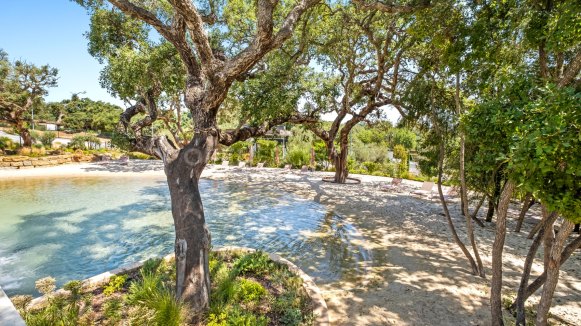
Orion took over management, and its CEO, Marc Topiol, moved fast. He sold assets such as the port office and priced Ribera del Marlin aggressively to clear it. The strategy centred on La Reserva, where upgrades to the golf course and clubhouse paid off. In 2017 Cerberus sold its remaining stake to Orion, and La Reserva Beach Club opened around its artificial lagoon, used by Sotogrande S.A. mainly to bring in buyers. NH Hotels had earlier leased El Cucurucho beach club to Trocadero for 21 years. By 2018, La Reserva prices were back at their 2003 levels.
Land repriced, and off-plan done right
Land that had changed hands at peak prices in the mid-2000s now traded at a fraction of them. After the original developer, who was to build on the land that is now Senda Chica, went bankrupt, the land was sold to Lemon Promotions at roughly 70% below its 2004 price. The La Finca land was resold to French developers for €11 million in 2018 and completed by Kronos in 2021.
We handled the exclusive marketing and sales of Senda Chica, and it is the clearest example we know of off-plan done at the right point in the cycle. Its 102 homes launched off-plan in 2019 from €495,000. Within a few months more than half were reserved, which allowed the developers to secure bank financing and start building. Most sold before completion. Today they trade at €700,000–950,000.
The same pattern runs through La Reserva. El Mirador, five villas soft-launched in 2017 to raise La Reserva’s profile, was built in 2020, and all five sold in 2020–2021 for €6–11 million each. One of the original buyers, from Kuwait, has since resold privately. These buyers weren’t chasing rental returns. They were buying privacy, views, a protected position in La Reserva and very high security.
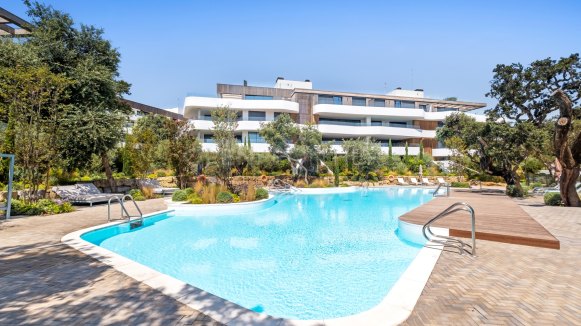
Village Verde launched off-plan in 2019, developed by Sotogrande S.A. Phases one and two are complete, and it won Porcelanosa’s Design of the Year award in 2025. Apartments from the first off-plan batch, bought at around €650,000, are now coming to market at around €900,000. Later phases launched at higher prices and were finished later, so their owners have seen less growth so far. Once again, the earliest buyers did best.
The Seven and The Fifteen also launched off-plan in 2019. In The Fifteen, Villa Vida sold for €12.5 million and Villa Sense for €14 million in 2025, and Villa Niwa for €23.75 million. Villa Dune came to market in August 2026 at €13.95 million. Sales like these barely show in official statistics, which is why we explain why the official data understates Sotogrande and what real price growth looks like in our market reports.
After 2021, prices rose sharply. Remote work pushed buyers towards homes with gardens and space, and demand from abroad grew. Andalucía’s change of regional government in January 2019 shifted the tax and political climate, Sotogrande International School grew to around 1,300 pupils, and the war in Ukraine from 2022 brought a further wave of expatriate buyers. Supply couldn’t keep up, because Sotogrande had reached the limits of its geography. Our Q3 2026 market report looks at where that leaves the market today.

The planning ceiling: what’s left to build
Sotogrande still runs on its 1987 master plan, which allows more building than the resort now wants. A new plan to reduce density was drawn up in 2007 by Sotogrande S.A., then owned by NH Hotels. It has still not been approved. (If you are weighing up land, our guide to suelo urbano vs urbanizable explains how land classification affects what you can build.)
A handful of large development plots are still available in Sotogrande, and once they are gone, there is very little land left to build on. Open Frontiers has access to these plots for developers and investors looking for a site here.
In 2024 Sotogrande S.A. priced its remaining La Reserva plots at around €330/m², with the best ones already sold, and began building villas itself. By November 2026, idealista’s average asking price for plots in La Reserva was €384/m². That figure covers all sellers, so it isn’t directly comparable with Sotogrande S.A.’s list price, but the direction is clear. Not so long ago, between 2010 and 2014, the banks were selling the same land for €65–110/m².
The newest projects reflect the same limits: ACCIONA’s 49-home Las Villas, due in 2028, a third Village Verde phase of lakeside villas, and a handful of schemes still at planning stage. The Gibraltar–EU treaty that removed border controls in July 2026 may yet matter for the region, as the reopenings of 1982 and 1985 did. We haven’t seen it in our enquiries yet; it is early, and the wider market is in an unusual moment.
What sixty years of cycles teach buyers and sellers
- Read the plot, not the brochure. A plot’s size and position tell you which market it was born into. The smaller A and B plots came out of a recession, while the larger C, D and G plots came out of recoveries. That history still shapes density, privacy and what can be built today, so ask why a plot is the size it is before you ask what it costs.
- Watch who owns the developer. McMicking built for friends, NH built for volume and the funds built for a profitable exit. Each change of owner changed what was built, how fast and at what price. When you buy a new home in Sotogrande, the strategy of the company behind it matters as much as the architect’s drawings.
- Off-plan rewards good timing and the ability to wait. Senda Chica, Village Verde and The Fifteen show what early buyers gain when a project launches at the right point in the cycle. Ribera del Marlin and Cortijos de la Reserva show what happens when completion lands in a downturn. Before you commit, ask how many units must be pre-sold before the bank finances the build, how your deposits are guaranteed, and whether you could hold for ten years if you had to.
- Sotogrande recovers, but on its own clock. Every downturn in this history, in the 1970s, the late 1980s and after 2008, has been followed by recovery. But recovery has sometimes taken a few years and, for some off-plan buyers after 2008, close to two decades. The owners who lost money were mostly the ones who had to sell at the bottom.
- For sellers: forced sellers set the bottom. Prices in Sotogrande have rarely fallen because owners lost faith. They fell when banks, insolvent developers or over-borrowed owners had to sell. If you aren’t one of them, timing and positioning are on your side, and patience has a long track record here.
Sixty years in the same place
History is the one thing a newcomer to Sotogrande can’t buy. Open Frontiers was founded in 1996 and has worked in Sotogrande for more than two decades, through the last crash, the fund era and the recovery. (Our own story is told in The Border We Used to Build, and the One We Cross Now.) That is why we can tell you not only what a property is worth today, but why.
Borja Goday, a former CEO of Sotogrande, has known our team for more than fifteen years. In a review he wrote for us, he said: “Their historical knowledge of the ups and downs of this market has added a lot of value to several of the decisions I have made there.”
If you are weighing a purchase or a sale, ask us for a private valuation and an honest read of your zone.
About the author
Innin Buyl is Director of Sales at Open Frontiers, the agency founded by her father, Ben Buyl, in 1996. She grew up in Sotogrande and attended Sotogrande International School, a story she tells in Thirty Years of Open Frontiers. She is a registered real estate agent (API, COAPI) with GIPE accreditation, recognised by CEPI at European level, teaches real estate investment at Schellhammer Business School, and is completing a doctorate (DBA) focused on real estate.
Sources
- Open Frontiers archive: “Sotogrande market over the years, 1963–2024” (September 2024), and Open Frontiers transaction records to November 2026.
- NH Hotel Group, NH Hotel Group sells Sotogrande for €225 million, 17 October 2014.
- HM Government of Gibraltar, 40 years of the opening of the border, 1985–2025.
- Valderrama Golf Club history.
- Real Club de Golf Sotogrande, Today’s Golfer.
- Sotogrande S.A., Village Verde, Porcelanosa Design of the Year 2025.
- idealista, average plot asking price, La Reserva, November 2026.