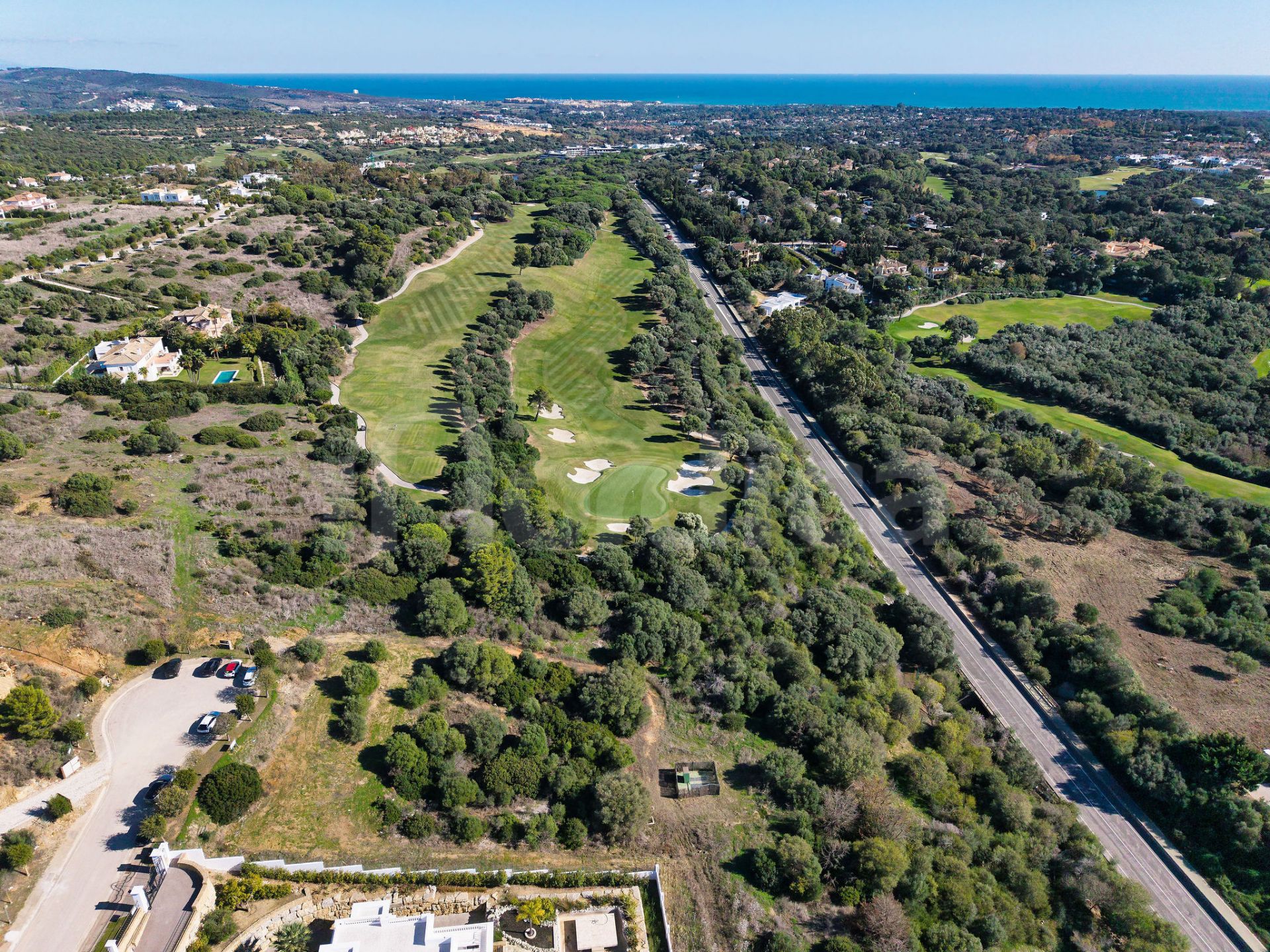
The Rules of La Reserva de Sotogrande, Explained: What You Pay, What You Can Build and What to Ask Before You Buy

Buying a plot or a house in La Reserva is not just buying land: the La Reserva Sotogrande rules come with it. You are joining an estate that decides who looks after the common areas, how much you pay for it, what you must submit before building and what is not allowed on your plot. Those rules are set out in the special regime of La Reserva de Sotogrande, a short document worth reading carefully before you buy.
We have read the text titled “Normas del Régimen Especial de La Reserva de Sotogrande” and explain it here in plain language. This is a summary in our own words of the version we have seen, which may have been amended. It does not replace your title deeds or a lawyer’s advice.
What It Applies To
According to the text, the plots and buildings of Subsector 50 of the Partial Plan of the Sotogrande Centre of National Tourist Interest form an estate made up of three kinds of assets:
- Open spaces of public ownership and use, as set out in the Partial Plan.
- Landscaped land over which some owners will have a right of private use.
- Land owned by Sotogrande, S.A.: secondary roads and car parks for common use.
Sotogrande, S.A., or the company that replaces it, provides the estate’s urban services.
Who Looks After La Reserva
Until the construction and sale of the whole estate is complete, upkeep and services are the responsibility of Sotogrande, S.A. or of the person or entity to which it transfers ownership. That covers the open spaces, the public-use areas, the installations and the privately owned elements for common use.
The regime allows for Sotogrande, S.A., once that phase is over, to keep the same system or to set up an Urban Maintenance Entity (Entidad Urbanística de Conservación). In that case, its statutes are approved by the town council and every owner becomes a member simply by being an owner, directly or through their communities, with payment obligations shared according to the buildable area of each plot.

What Services Are Included
- Cleaning and rubbish collection, as a complement to the municipal service, for waste that is too bulky to count as household rubbish.
- Gardening of the public spaces.
- Security surveillance of the whole estate.
- Rodent control and mosquito treatment.
- Maintenance of the irrigation water network, hoses and fire extinguishers, the storm-water network, the verges, the public lighting, and the roads and their signage.
If new services are created in future, they are billed separately and in proportion to the chargeable area.
What You Pay: The Maintenance Charge
This is what buyers ask about most. The text sets it out like this:
- How it is calculated. A general annual charge (canon) per square metre of chargeable area, set in proportion to the maximum buildable area of each plot. Your share is provisional until final shares are established.
- How it is reviewed. Every year, using the higher of two indices: the consumer price index (CPI) and the wage-review index of the construction collective agreement for the province of Cádiz. Exceptionally it can go up or down without reference to those indices if the cost of services changes for unforeseen reasons, with a justification that need only be communicated.
- How it is paid. In two half-yearly bills. Late or missing payment carries default interest of 15% a year once 30 days have passed since the bill was issued.
- What is left out. Services not provided for and extraordinary works or repairs are not part of the charge: they are shared through special levies (derramas) in proportion to the chargeable square metres. Nor are each owner’s own taxes and fees.
Because the amount is updated every year, what matters is the current figure. It is worth asking for it in writing before you buy, together with the latest bills for the plot.
Co-Ownership and Right of Use, in Brief
Each private plot carries an inseparable share in the co-ownership of the rest of the estate’s land: open spaces and, where applicable, private secondary roads and car parks. Until that co-ownership is consolidated, some plots have an exclusive right of use over certain common areas. When it is consolidated, that right ends, but the owner keeps private use of the land concerned.
If You Are Going to Build: The Project Review

Before applying for the municipal building licence, you must submit the basic project to the technical office of Sotogrande, S.A. They review six things:
- Changes to the ground. Any planned change to the ground level of the plot, shown on a topographical plan of the modified terrain. The text sets no figures for this.
- Distance to the boundaries. How far the house sits from each edge of the plot: public, private or the golf course. The special regime gives no metres here; they come from the planning rules. In the planning rules published by Sotogrande, S.A. (in Spanish) for detached houses in phases 1 and 2 of Subsector 50, the minimums are 6 metres from the roads, 3 metres from private neighbours and 15 metres from the golf course. Other plots can have different figures, so check the rules for yours.
- Service connections. How the house will connect to the estate’s service networks. The text does not go into detail.
- Perimeter walls. The planned height on each boundary. The limits are in the next section, together with what we see in practice.
- Replanting. What you will plant to replace any vegetation the works affect. What is required is set out under “Trees” below.
- Existing vegetation in the first fifteen metres. On plots bordering the golf course, the vegetation already there must be respected. It matches the 15-metre minimum distance from the course in the planning rules.
Sotogrande, S.A. has 30 days from submission to approve the project or issue a reasoned report of non-compliance. If it does not respond within that period, the project is deemed approved. If there is an objection, you have to correct the project and submit it again. If the rules are not followed, Sotogrande, S.A. can object in the licence file at the town council and immediately halt any work begun without following these measures.
If building is what you have in mind, you may also be interested in our analysis of construction costs in Sotogrande and our report on sustainable property.
What the La Reserva Rules Say Is Not Allowed
These are the rules as the regime sets them out. In practice, some are not applied as written, and we say so where we have seen it.

- Wells and boreholes. They are prohibited on all plots. If the rule is broken, Sotogrande, S.A. can demand an annual compensation equal to the billing of one cubic metre of water for each square metre of plot, at the drinking-water rate in force. On a 2,000 m² plot, for example, the calculation would start from 2,000 m³ a year.
- Perimeter walls. They must be built before the house. They cannot exceed 1.5 metres above the level of the adjoining verges and must be made of sandstone. Those bordering the golf course, also in sandstone, must be between 1 and 1.5 metres high. That was the original idea for La Reserva. In practice, as we can see around the estate, these rules are not being enforced. So do not assume that a wall you see next door is what is allowed on your plot: ask Sotogrande, S.A. what it requires for yours.
- Trees. They may not be removed, except those needed to build the house. Native trees, such as cork oaks and wild olives, affected by the works or the infrastructure must be transplanted, and if the transplant fails they are replaced by three nursery plants of the same species.
- Next to the golf course. On plots bordering the course, the trees in the “non edificando” (no-build) easement zone must be respected. To alter them, you must submit a design with new evergreen native trees (wild olive, cork oak, carob, holm oak, laurel, strawberry tree, Lusitanian oak or oak), in similar number and size to the existing ones. If this is not done, Sotogrande, S.A. can replant at the owner’s expense.
- Materials and machinery. During works you may not use neighbouring plots, verges or roads to store materials, and the owner is responsible for any damage caused, directly or by their contractors. In practice, we often see neighbouring plots used for this, with the owners’ explicit permission.
- Advertising signs and hoardings. Prohibited, unless approved beforehand and in writing. In practice, in Sotogrande you cannot put a “for sale” sign on a house: it is only allowed on plots. Developers can put their own marketing material on their façades, but agencies cannot.

What to Ask Before You Buy
- Who provides the upkeep services today, what is the current maintenance charge and what does it include?
- Are any special levies or extraordinary costs planned?
- Which specific restrictions affect this plot, which of them are applied in practice, and which rights of use does it include?

Thinking of Buying or Building in La Reserva?
The rules are not an obstacle, but it is worth knowing them before you commit. If you would like to know how they would affect a particular plot or house, write to us and we will go through them together. Get in touch with our team. You can also browse our properties for sale and our new developments.
Keep Reading
- Sustainable Property: What Is Changing Around the World and What It Means for a Home in Sotogrande
- Construction Costs Are Rising. Sotogrande Isn’t Slowing Down.
- Sotogrande Property Market Q3 2026: Spain Is Slowing. Sotogrande Is not.
About the Author
Innin Buyl is Director of Sales at Open Frontiers, the Sotogrande agency founded by her father, Ben Buyl, in 1996. She grew up in Sotogrande, a story she tells in Thirty Years of Open Frontiers.
This article summarises the special regime of La Reserva de Sotogrande as it appears in the version we have consulted, which may have been amended. It is for information only. It is not legal, tax or financial advice.